

Saved Bookmarks
| 1. |
Explain the equivalent resistance of a series and parallel resistor network. |
Answer» Solution :Resistors in series: When two or more resistors are connected end to end, they are said to be in series. The resistors could be simple resistors or BULBS or heating elements or other DEVICES. Fig. (a) shows three resistors Rp R2 and R3 connected in series. 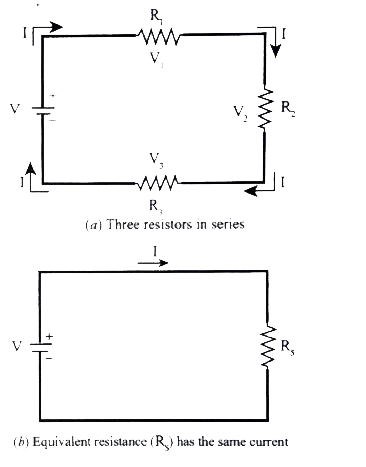 The amount of charge passing through resistor R] must also pass through resistors `R_(2)` and `R_(3)`since the charges cannot accumulate anywhere in the circuit. Due to this reason, the current I passing through all the three resistors is the same. According to Ohm’s law, if same current pass through different resistors of different values, then the potential difference ACROSS each resistor must be different. Let `V_(1), V_(2)`and `V_(3)`be the potential difference (voltage) across each of the resistors`R_(1),R_(2)`and `R_(3)`respectively, then we can WRITE `V_(1) = IR_(1),V_(2) = IR_(2)`and `V_(3) = IR_(3)`. But the total voltage V is equal to the sum of voltages across each resistor. `V = V_(1) + V_(2) + V_(3)` `= IR_(1) + IR_(2) + IR_(3)` `V = I(R_(1) + R_(2) + R_(3))` `V=I.R_(3)` Where `R_(S)` is the equivalent resistance. `R_(S) = R_(1) +R_(2) + R_(3)` When SEVERAL resistances are connected in series, the total or equivalent resistance is the sum of the individual resistances as shown in fig. |
|