

Saved Bookmarks
| 1. |
Explain the estimation of nitrogen of an organic compound by b) Kjeldahl's method |
Answer» Solution :Eslimation of `N_(2)` byKjeldahl's method : In this method the organic compound is heated with conc, `H_(2)SO_(4)` in presence of a small amount of `CuSO_(4)`. Then `N_(2)` is quantitively CONVERTED into ammonium sulphate. The contents of the flask are transferred into another flask and heated with excess of `NaOH` solution to LIBERATED is passed and ABSORBED in a knwon vol. of known conc. `H_(2)SO_(4)` (excess). Now the excess of acid remained after the neutrallsation by `NH_(3)` is lirated against a slandard solution of akali. From this, the amount of `H_(2)SO_(4)` used to neutralise `NH_(3)` is calculated. From this the mass of ammonia formed is calculated and from the `%` of `N_(2)` gas is calculated. 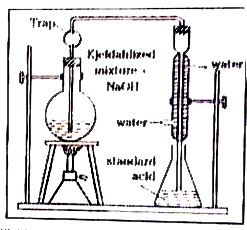 Organic compound `+H_(2)SO_(4)RARR(CH_(4))_(2)SO_(4)` `(NH_(4))_(2)SO_(4)+2NaOH rarr Na_(2)SO_(4)+2H_(2)O+2NH_(3)` `2NH_(3)+_(2)SO_(4)rarr (NH_(4))_(2)SO_(4)`. Calculations : Mass of organic compound = a g Vol. of `H_(2)SO_(4)` Initially taken = V ml. Molarity of `H_(2)SO_(4)=M` Vol. of `NaOH` consumed after complete neutrallsation `=V_(1)ml`. Molarity of `NaOH =M` `2NaOH +H_(2)SO_(4) rarr Na_(2)SO_(4)+2H_(2)O` Then from the formula, `(NaOH)=(MV_(1))/(n_(1))=(MV_(2))/(n_(2))(H_(2)SO_(4))` We get, `(MV_(1))/(2)=(MV_(2)/(1) or V_(2)=(V_(1))/(2)" ml. "` `therefore"Vol. of "H_(2)SO_(4)" neutralilsed by "NH_(3)` `=(V-(V_(1))/(2))ml` `=(2(V-(V_(1))/(2))ml` of M molar `NH_(3)` solution. `"1000 ml. of 1 M"NH_(3)` solution. 1000 ml. of `1 M NH_(3)` solution contains 17 g of `NH_(3)` of 14 g of `N_(2)`. `therefore 2(V-(V_(1))/(2))` ml of M molar `NH_(3)` solution .............? `=(14xxM xx2(V-(V_(1))/(2)))/(1000)g" of "N_(2)` `therefore % " of Nitrogen"` `=(14xxMxx2(V-(V_(1))/(2)))/(1000)xx(100)/(a)` |
|