

Saved Bookmarks
| 1. |
Explain the formation of stationary waves in stretched strings and hence deduce the laws of transverse wave in stretched strings. |
|
Answer» Solution :A string is a metal WIRE whose length is large when compared to its thickness. A stretched string is fixed at both ends, when it is plucked at mid point, two reflected waves of same amplitude and frequency at the ends are travelling in opposite direction and overlap along the length. Then the resultant waves are known as the standing waves ( or) stationary waves. Let two transverse progressive waves of same amplitude a, wave length `lambda ` and frequency 'v', travelling in opposite direction be given by `y_(1) = a sin ( kx - omega t ) ` and `y_(2) =a sin ( kx +oemga t ) ` where ` omega = 2piv ` and `k = ( 2pi)?( lambda)` The resultant wave is given by`y= y _(1) + y _(2) ` `y = a sin ( kx + omega t )+ a sin (kx + omega t ) ` `y = ( 2a sin kx ) COS omegat ` ` 2 a sin kx =` Amplitudeof resultant wave. It dependson 'kx' . If ` x = 0 , ( lambda )/(2) , ( 2lambda)/(2) , ( 3lambda)/(2) ,.....`etc,the amplitude =ZERO. These positions are known as "Nodes". If `x= ( lambda)/(4), ( 3lambda)/(4) , ( 5 lambda)/(4),......` etc, the amplitude= maximum (2a) These positions are called "Antinodes". 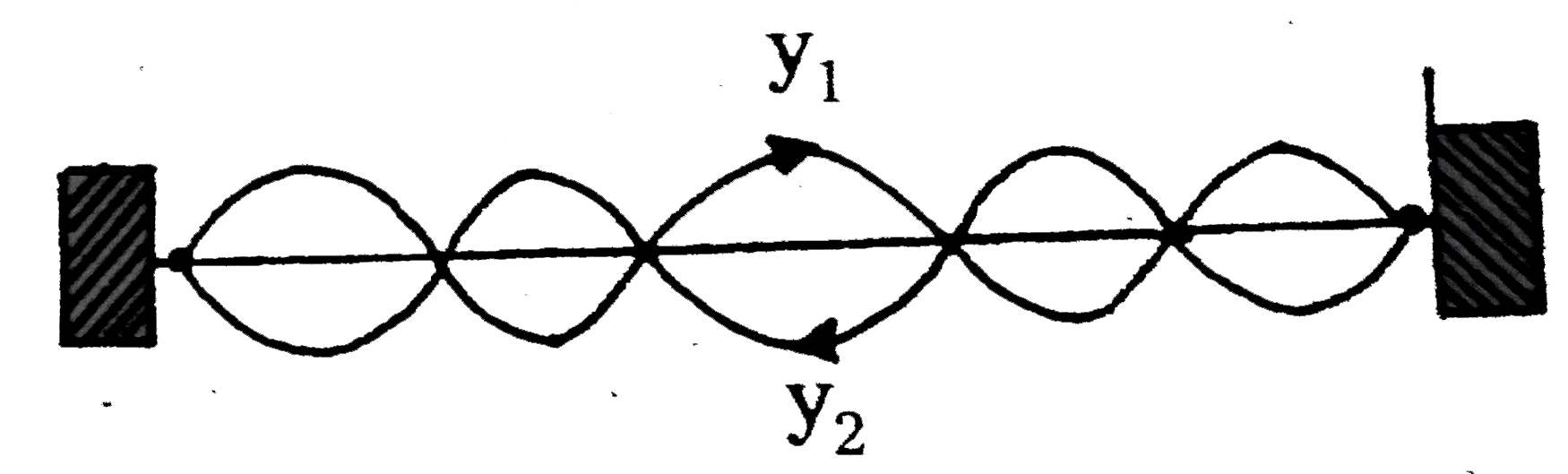 If the string vibrates in 'P' segments and'l' is its length then length of each segment `= ( l)/( p)` Which is equal to `( lambda)/(2)` ` :. ( l)/(p) = ( lambda)/(2) implies lambda = ( 2l)/( P)` HARMONIC frequency `v =(upsilon)/(lambda) =( upsilonP)/( 2l)` `v = ( upsilonP)/(2l)`...(1) If'T' is tension( streching force ) in the string and '`mu`' is liner density thenvelocity of transverse wave (v) in the string is ` v =sqrt((T)/(mu))`...(2) From the EQS. (1) and (2) Harmonic frequency `v= (P )/( 2l) sqrt((T)/(mu))` P=1 then it is called fundamental frequency ( or) first harmonic frequency `:.` Fundamental Frequency `v = (1)/(2l) sqrt((T)/(mu))`...(3) Law of Transverse Waves Along StretchedString `:` Fundamental frequency of the vibrating string `v = (1)/(2l) sqrt((T)/(mu))` First Law `:`When the tension (T) and linear density `( mu )`are constant, the fundamental frequency (v) ofa vibrating string is inversely proportional to its length. ` :.v prop (1)/(l) implies vl` =constant, when T and `' mu'` constant. Second Law `:` When the length (l) and its, linear density (m) are constant the fundamental frequency of a vibratingstring is directly proportional to the square root of the stretchingforce (T). `:. v prop sqrt(T) implies (v)/( sqrt(T))` = constant , when 'l' and 'm' are constant. Third Law `:` When the length ( l)and the tension (T) are constant , the fundamental frequency of a vibrating string is inversely proportional to the square root of the linear density ( m ). `:.v prop (1)/(sqrt(mu)) implies v sqrt( mu ) `= constant , when'l' and 'T'are constant. |
|