

Saved Bookmarks
| 1. |
Explain the phenomenon of Dispersion. Red and blue light rays are incident on a given prism. Explain which will have greater value of minimum deviation. |
|
Answer» Solution :Dispersion of Light The phenomenon of splitting of white light into its constituent colours, on PASSING through a PRISM is called Dispersion of light. The band of colours so obtained is called a spectrum. White light e.g. light from the sun, when seen through a prism, appears coloured. 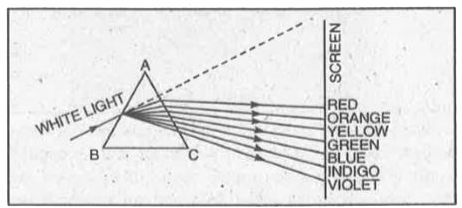 Thus white light splits into different colours, on passing through a prism. The colours in the order of decreasing deviation are Violet, Indigo, Blue, Green, Yellow, Orange and Red (Fig.). Obviously, the deviation is maximum for violet colour and minimum for red colour, Cause of Dispersion The wavelength of red light (in the visible spectrum) is much larger than that of violet light and the wavelength of orange, yellow, green, blue and indigo colours lying in between red and violet light GRADUALLY decreases in the above order. According to Cauchy.s FORMULA, `mu=a+(b)/(lambda^(2))+(c)/(lambda^(4))`, where `lambda` is the wavelength of light and `mu` is the refractive INDEX for the particular wavelength i.e. velocity of light is different for different wavelengths. As the wavelength of blue light is smaller than that of red light, the refractive index for blue light is greater than that for red light. i.e. since `lambda_(b) lt lambda_(r)` `:. mu_(b) gt mu_(r)` We know that, the deviation `delta` for a small angled prism is given by `delta=(mu-1)A` So `lambda_(b) gt lambda_(r)` |
|