

Saved Bookmarks
| 1. |
Explain the phenomenon of hysteresis in magnetic materials. |
|
Answer» Solution :A complete cycle of magnetisation [i.e, graph between magnetisation M (or total magnetic field B developed in the sample) of the sample and magnetising INTENSITY H] for a given ferromagnetic material (say steel) is being shown in Fig. The curve obtained is called hysteresis curve. From this graph, we draw following conclusions: (i) Initiallyas `vecH` is raised from its zero value `vecB` also RISES from zero toa s saturation value `vecB_m` and it is being represented by the curve. OA . But the curve OA does not retrace itself as `vecH` is reduced . `vecB_m` is called "magnetic saturation" of the given sample . (iii) As `vecH` is reduced, the curve is along AB. Point B indicates the value of magnetic field B left behind even when `vecH` is reduced to zero. This value of field `vecB` , (given by OB) is called .RESIDUAL magnetism. or .retentivity. or .remanence.. 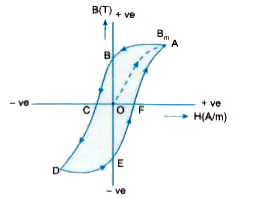 (iii) To reduce `vecB` to zero we have to increase value of `vecH` in the REVERSE direction. In figure point C represents the state of `vecB` =0 . Value of `vecH` corresponding to point C i.e. `vecH_C` is known as .coercive force. or .coercivity.. (iv) No segment OA, AB, BC, CD ... etc., of the curve is linear. It means that `vecB` is not directly PROPORTIONAL to `vecH` over any appreciable range. (v) Lagging behind of `vecB` as compared as `vecH` is known as the .Hysteresis. and the magnetisation cycle curve is known as thehysteresis curve. (iv) The area within the B-H loop represents the energy dissipated per unit volume per cycle in the material. |
|