

Saved Bookmarks
| 1. |
Explain the principle of a potentiomater. |
|
Answer» SOLUTION :Principle of a potentiometer : The potential difference across any length of a potentiometer wire is directly proportional to that length. field Explanation: The potentiometer consists of a long uniform wire AB of length L, stretched on a wooden board. A CELL of constant emf E is connected across AB, as shown in the figure. 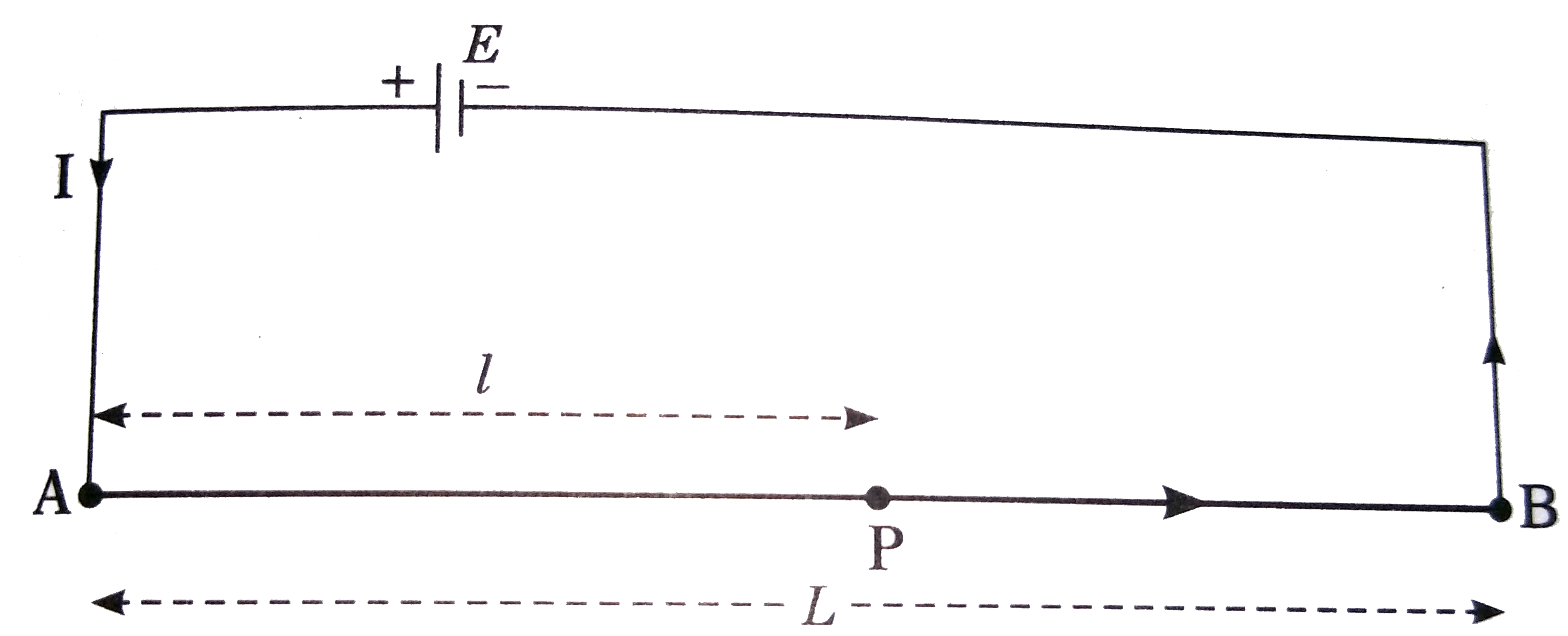 As the steady current PASSES through the wire from A to B, there is a tall of potential along the wire from A to B. As the wire has a uniform cross section, its resistance per unit length `lamda` is constant. Hence, the resistance of the wire is `Llamda`Therefore, the potential difference (p.d.) across the wire is `V_(AB)="current"XX "resistance"=ILlambda` `therefore I=V(V_AB)/(L lamda)` Let P be any point of the wire between A and B. Let AP-L Then the resistance of the wire AP is 2. The p.d. between A and P is `V_(AP)="current" xx "resistance of AP"=Illambda` where `=(V_(AB))/(L)=k` (constant), as `V_(AB) and L` are CONSTANTS. The quantity k represents the fall of potential per unit length of the wire, which is called the potential gradient along the wire. `therefore V_(AP)=kltherefore V_(AP) alpha l` Thus, the p.d. across any length of the potentiometer wire is directly proportional to that length. |
|