

Saved Bookmarks
| 1. |
Explain the role of redox reactions in titrimetre processes and galvanic cells. |
|
Answer» Solution :Role of redox REACTIONS in titrimetric quantitative analysis : Titrimetric analysis involves two substances. They are (1) a solution of known concentration or a standard solution and (2) a solution of unknown concentration. The first solution is also known as Titrant. The second solution is also knwon as Titrand. The process of adding a standard solution to the titrand till the reaction is just complete is called titration. The point at which the titrand just completely reacts with the standard solution is called "equivalence point" or "end point," In redox reactions the completion of the titration is detected by a suitable method like (a) observing a physical change. Ex : The light pink colour of `KMnO_(4)` titrations. (b) by USING a reagent known as indicator which gives a clear visual change in its colour. Ex(1) In `Cr_(2)O_(7)^(-2)` (dichromate) titrations, diphenyl amine is used as a reagent and at the end point it produces intense blue colour due to its oxidation by `Cr_(2)O_(7)^(-2)`. Ex (2) In the titration of `Cu^(+2)` with `I^(-)` (Iodometry) `2Cu_((aq))^(+2)+4I_((aq))^(-)toCu_(2)I_(2(s))+I_(2(aq))` The `I_(2)` formed in the redox reaction gives a deep blue colour with starch solution, added to the flask. IN this way redox reaction are taken as the basis for titrimetric analysis with `MnO_(4)^(-),Cr_(2)O_(7)^(-2)` etc. as oxidising agents and `S_(2)O_(3)^(-2)` etc. as reducing agents. Role of Redox reaction in galvanic cells : When a zinc rod is kept in copper sulphate solution then the following redox reaction takes place. 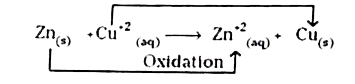 In this redox reaction the transfer of electrons from `Zn_((s))` to `Cu_((aq))^(+2)` takes place directly. The same transfer of clcctrons can also be done indirectly in a galvanic call (Daniel cell). Cells in which chemical energy is converted into electrical energy are called galvanic cells. Daniel cell is a best example for a galvanic cell. The Daniel cell consists of two beakers containing zinc rod dipped in `ZnSO_(4(aq))` solution in ONE beaker and a copper rod dipped in `CuSO_(4(aq))` solution in a second beaker. The two beakers are connected by an inverted U-tube, known as salt bridge. The two rods are connected by means of wires to the terminals of an ammeter. Redox reaction takes place contains both oxidised and reduced forms of the respective species. The two types of species present together in each beaker is called a redox COUPLE. Each beaker contains a redox couple. The oxidised and reduced forms are separated by a vertical line or a slash. Ex : `Zn_((s))//Zn_((aq))^(+2)` 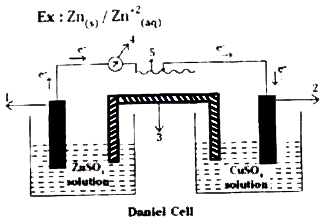 In the above arrangement the two redox couples are represented by `Zn^(+2)//ZnandCu^(+2)//Cu`. As the metal is in two different oxidation states at the interface (say `Zn//Zn^(+2)`), some potential is developed, which is called 'electrode potential'. These electrode potentials are very useful in METALLURGY, electro-plating etc. In this way redox reaction play an important role in galvanic cells. |
|