

Saved Bookmarks
| 1. |
Explain the use of a metre bridge for finding unknown resistance. |
|
Answer» Solution :It works bridge is balanced, we get `(P)/(Q)=(R)/(S)`. it consists of uniform wire AC one metre long, soldered to the ends of two THICK RECTANGULAR strips of copper A and C on the wooden base. A metre scale is also fitted on the wooden board. Another copper strip D is also fixed on the wooden board as shown in the figure. R is a resistance BOX and S is unknown resistance. positive of battery is connected to point A and negative to point C. A SLIDING contact B called jockey can be moved along the graduated scale. G is a galvanometer connected between D and B. 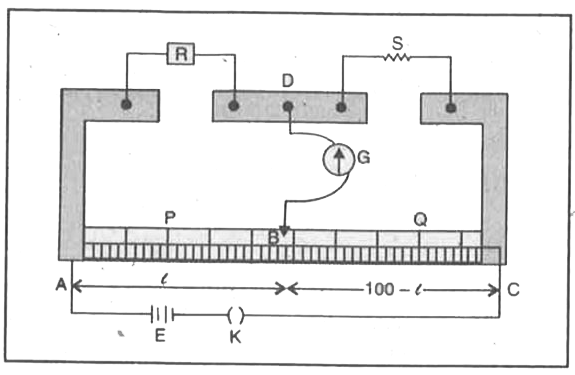 Key K is inserted and a known resistance R is taken out from the resistance box. move the jockey on the wire till for a certain position B, galvanometer shows no deflection. the bridge is then said to be balanced. if P(=lr) and Q[(=(100-l)r] are the resistance of part AB and BC, then we have `(P)/(Q)=(R)/(S)` or `(R)/(S)=(P)/(Q)=(lr)/((100-l)l)` or `(R)/(S)=(lr)/(100-l)` or `S=(100-l)/(l)R` Knowing l, and R, S can be calculated. |
|