

Saved Bookmarks
| 1. |
Explain the variation of molar conductivity with concentration for strong and weak electrolytes. |
|
Answer» Solution :(1) Molar conductivity is the conductance of all the ions produced from one mole of an electrolyte. The molar conductivity of both, strong and weak electrolytes increases with dilution or the decrease in concentration of the ELECTROLYTIC solution. As thedilution increase , the dissociation of the electrolyte increases, hence the total number of ions increases, therefore, the molar conductivity increases. (3) Molar conductivity `^^_(m)`is given by `^^_(m) = (k)/(C) = k XX V` where k isconductivityand C or V are concentration or dilution of the solution respectively. (4) On dilution, the molarconductivity of strong electrolytes increaserapidly and APPROACHES to a maximum limiting VALUE at infinitedilution or zero concentration and respresented as `^^ oo` or `^^_(0)` or `^^_(m)^(0)` . (5)In caseof weakelectrolytes, the molarcondutivityis lowandcondutivityis lowandincreaseslowly in highconcentrationregionbut incereaserapidlyat lowconcentrationor high dilutionsincetheextent of dissocitateinreasewith dilutionrapily. For strong electrolytes, the linear variation of molar conductivity (Am) with the concentration is represented by Kohlrausch relation, `^^_(m) = ^^_(0) - a sqrt(c)`where a isa constant . `^^_(0)`values for strongelectrolytescan be obtained by extrapolating the linear graph to zero concentration (or infinite dilution). However A, for the weak electrolytes cannot be obtained by this method, since the graph increases exponentially at very high dilution and does not intersect `^^_(m)` AXIS, 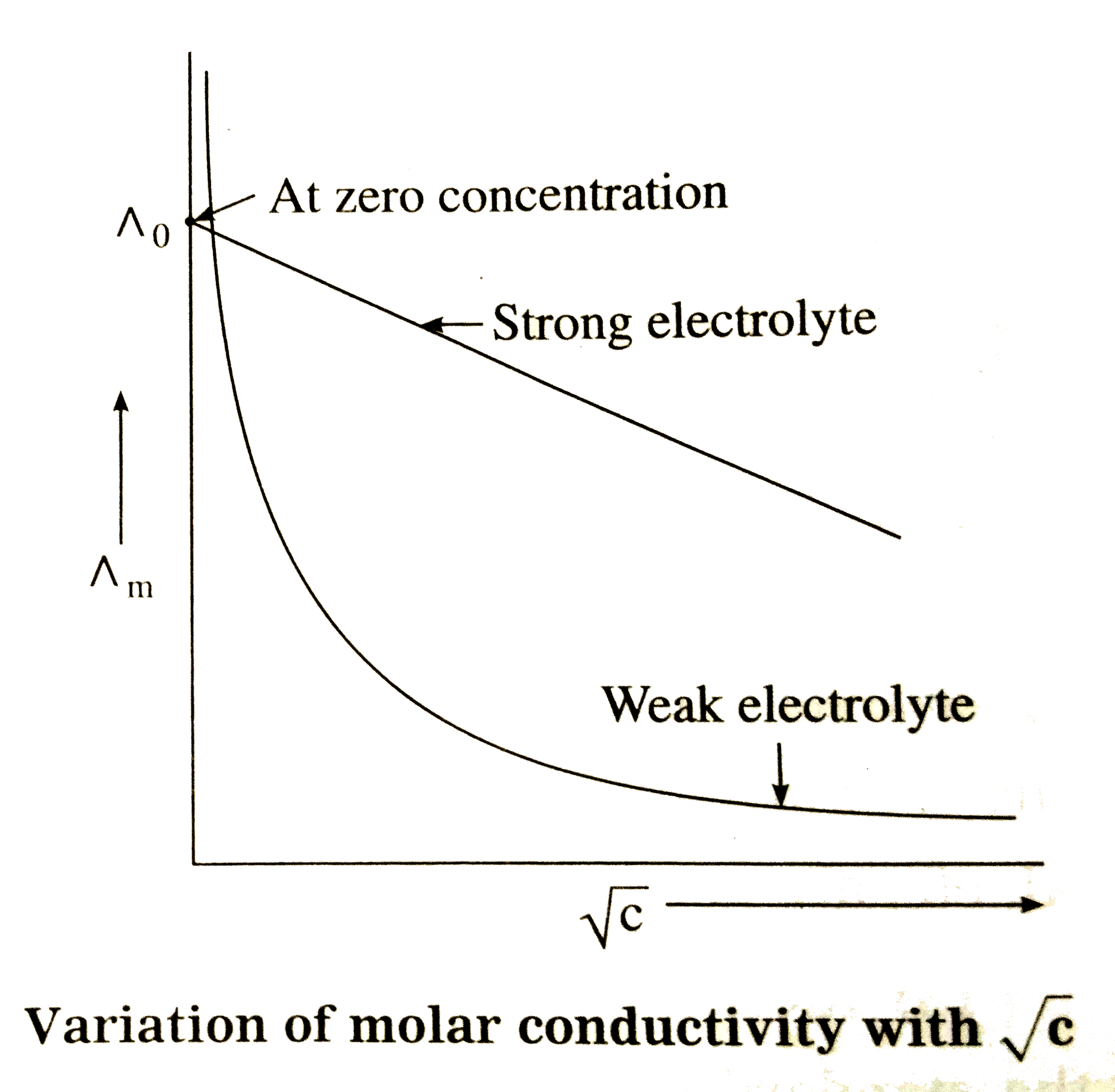
|
|