

Saved Bookmarks
| 1. |
Explain van't Hoff factor. |
|
Answer» Solution :Van.t HOFF introduced a factor i, known as the van.t Hoff factor, to account for the extent of dissociation or association. This factor i is defined as : `i=("Normal molar mass")/("Abnormal molar mass")` `=("Observed colligative property")/("Calculated colligative property")` `i=("Total number of moles of particles after association / dissociation")/("Number of molar of particles before asociation / dissociation")` Here abnormal molar mass is the experimentally determined molar mass and calculated colligative properties are obtained by assuming that the non - volatile solute is neither associated nor dissociated. In case of association, value of i is less than UNITY while for dissociation it is greater than unity, while when no association / dissociation, then i = 1 For example, the value of i for aqueous KCl solution is close to 2, while the value for ethanoic acid in benzene is nearly 0.5. Inclusion of van.t Hoff factor modifies the EQUATIONS for colligative properties as follows : `(P_(1)^(0)-P_(1))/(P_(1)^(0))=i(n_(2))/(n_(1))` Relative lowering of vapour pressure of solvent, Elevation of Boiling point, `Delta T_(b)=i K_(b)m` Depression of FREEZING point, `Delta T_(f)=i K_(f)m` Osmotic pressure of solution, `pi = iCRT = i((N)/(V))RT` 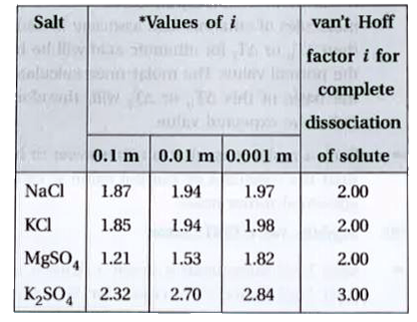
|
|