

Saved Bookmarks
| 1. |
Explain vapour pressure of solutions of solids in liquids. |
Answer» Solution :Liquids at a GIVEN temperature vapourise and under equilibrium conditions the pressure exerted by the vapours of the liquid over the liquid phase is called vapour pressure.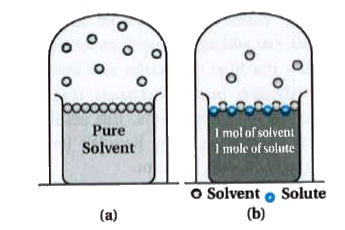 In a PURE liquid the entire surface is occupied by molecules of the liquid. If anon - volatile solute is added to a solvent to given a solution, the vapour pressure of the solution is solely from the solvent alone. This vapour pressure of the solution at a given temperature is found to be lower than the vapour pressure of the pure solvent at the same temperature. In the solution, the surface has both solute and solvent molecules, there by the fraction of the surface covered by the solvent molecules gets reduced. Consequently, the number of solvent molecules escaping from the surface is correspondingly reduced, thus, the vapour pressure is also reduced. The decrease in the vapour pressure of solvent depends on the QUANTITY of non - volatile solute present in the solution, irrespective of its nature. Let `p_(1)` be the vapour pressure of the solvent, `x_(1)` be its MOLE fraction, `p_(1)^(0)` be its vapour pressure in the pure state. Then according to Raoult.s law`p_(1)prop x_(1)` and `p_(1)=x_(1)xx p_(1)^(0)` The proportionality constant is equal to the vapour pressure of pure solvent, `p_(1)^(0)`. A plot between the vapour pressure and the mole fraction of the solvent is linear. 
|
|