

Saved Bookmarks
| 1. |
Explain Werner's theory of coordination compounds with suitable examples. |
|
Answer» Solution :Werner's theory : Werner's theory : POSTULATES : 1) EVERY complex compound has a central metal atom (or) ion. 2) The central metal shows two TYPES of valencies NAMELY primary valency and secondary valency. A) Primary valency : The primary valency is numerically equal to the oxidation state of the metal. Species or groups bound by primary valencies undergo complete ionization.These valencies are identical with ionic bonds and are non-directional. These valencies are represented by discontinuous lines (.....) Eg : `CoCl_(3)` contains `Co^(3+) and 3Cl^(-)` ions. There are three Primary Valencies or three ionic bonds. B) Secondary Valency: Each metal has a characteristic number of Secondary Valencies. They are DIRECTED in space around the central metal. The number of Secondary Valencies is called Coordination numbe (C.N .) of the metal. These valencies are directional in Nature. For example in `CoCl_(3). 6NH_(3)` Three `Cl^(-)` ions are held by primary Valencies and `6NH_(3)` molecules are held by Secondary Valencies. In `CuSO_(4).4NH_(3)" complex "SO_(4)^(2-)` ion is held by two Primary Valencies and `4NH_(3)` molecules are held by Secondary Valencies. 3) Some negative ligands, depending upon the complex, may satisfy both primary and secondary valencies. Such ligands, in a complex, which satisfy both primary as well as secondary valencies do not ionize. 4) The primary valency of a metal is known as its outer sphere of attraction or ionizable valency while the Secondary valencies are known as the inner sphere of attraction or coordination sphere. Groups bound by secondary valencies do not undergo ionization in the complex. 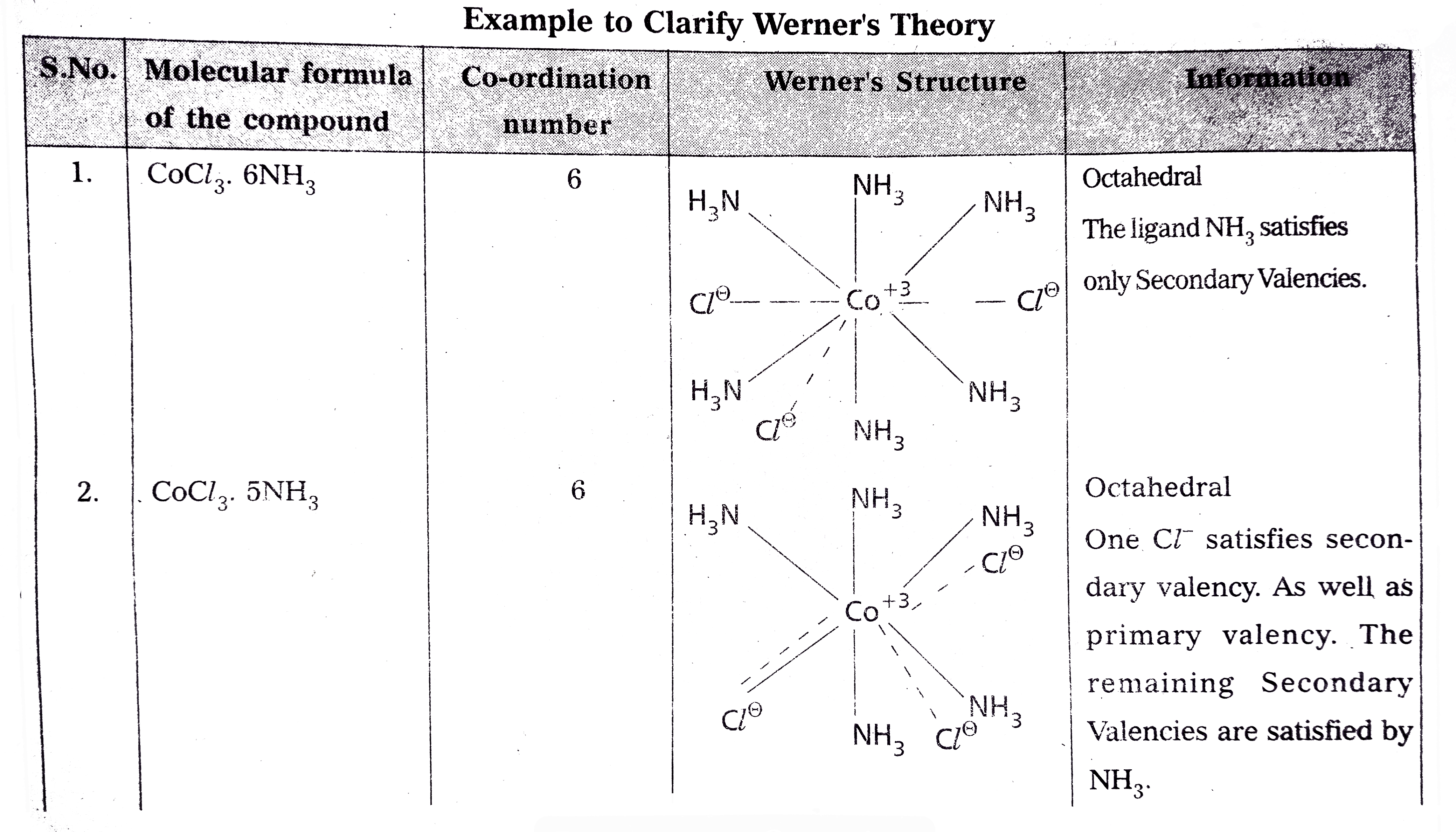 
|
|