

Saved Bookmarks
| 1. |
Explain why aryl halides are extermely less reactive towards nucleophilic substitution reactions. |
|
Answer» Solution :Aryl halides are extremely less reactive towards nucleophilic substitution REACTIONS DUE to the following reasons : (i) Resonance effect : In haloarenes, the electron pairs on halogen atom are in conjugation with `pi` - electrons of the ring and the following resonating structures are possible. 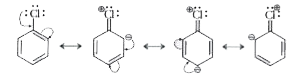 The C - Cl bond acquires a partial double bond character due to resonance. As a result, the bond cleavage in haloarene is difficult than haloalkane and therefore, they are less reactive towards nucleophilic substitution reaction. (ii) Difference in hybridisation of carbon atom in C - X bond : In haloalkane, the carbon atom attached to halogen is `sp^(3)` hybridised while in case of haloarene, the carbon atom attached to halogen is `sp^(2)` - hybridised. 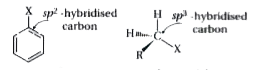 The `sp^(2)` hybridised carbon with a greater s - character is more electronegative and can hold the electron pair of C - X bond more tightly than `sp^(3)` -hybridised carbon in haloalkane with less s - chararcter. Thus, C - Cl bond length in haloalkane is 177 pm while in haloarene is 169 pm. Since it is difficult to break a shorter bond than a longer bond, therefore, haloarenes are less reactive than haloalkanes towards nucleophilic substitution reaction. (iii) INSTABILITY of phenyl cation : In case of haloarenes, the phenyl cation formed as a result of SELF - ionisation will not be stabilised by resonance and therefore, `S_(N)1` mechanism is ruled out. (iv) Electronic Repulsions : It is less likely for the electron rich nuclephile to APPROACH electron rich arenes. |
|