

Saved Bookmarks
| 1. |
Explain why (i) the dipole moment of chlorobenzene is lower than that of cyclohexyl chloride? (ii) Alkyl halides, though polar, are immiscible with water? (iii) Grignard reagents should be prepared under anhydrous conditions? |
Answer» Solution :(i) Due to greater s-character, a `sp^(2)`-hybrid carbon is more electronegative than a `sp^(3)-`hybrid carbon. Therefore, the `sp^(2)`-hybrid carbon of C-Cl BOND in chlorobenzene has less tendency to release electrons to Cl than `sp^(3)`-hybrid carbon of cyclohexyl CHLORIDE. 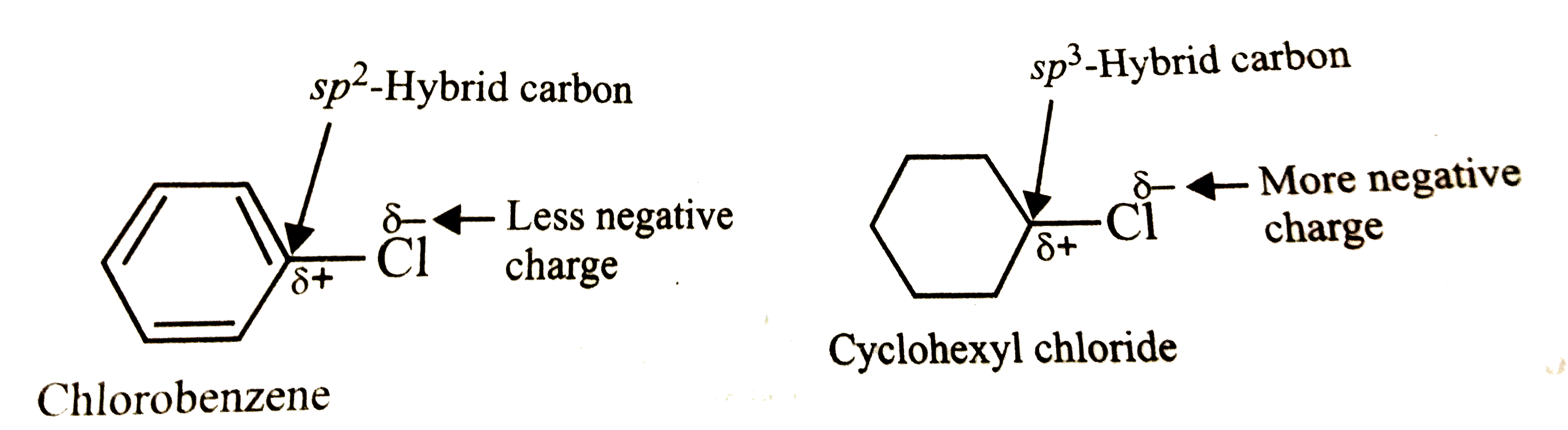 As a result, the C-Cl bond is chlorobenzene is less polar than in cyclohexyl chloride. in other words, the magnitude of negative charge, i.e., `delta^(-)` is less on Cl atom of chlorobenzene than in cyclohexyl chloride. 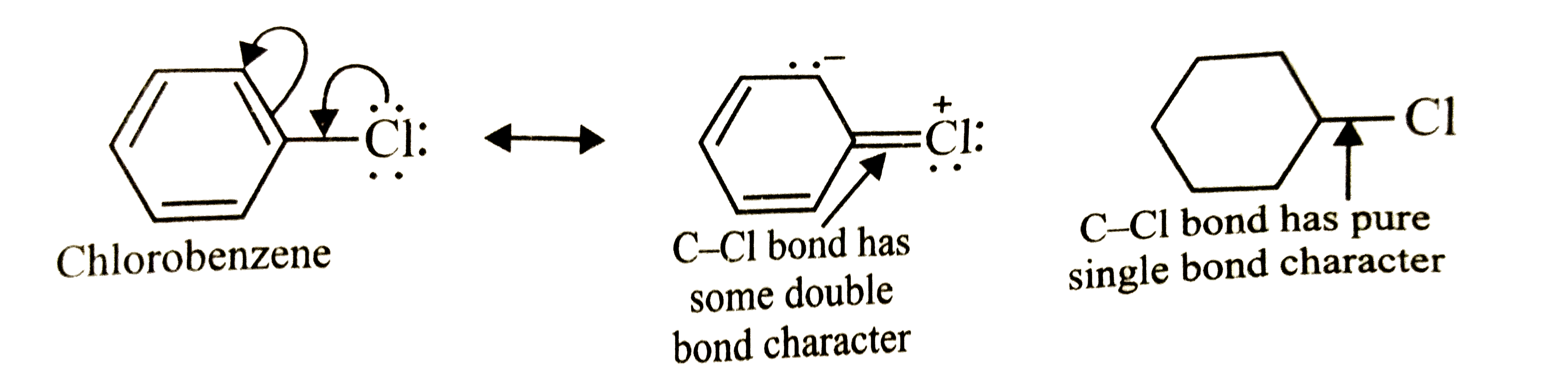 Further, due to delocalization of lone pairs of electrons of the Cl atom over the benzene ring, C-Cl bond in chlorobenzene acquires some double character while the C-Cl bond in cyclohexyl chlorie is a pure single bond. in other words, C-Cl bond in chlorobenzene is shorter than in cyclohexyl chloride. since dipole moment is a product of charge and distance, therefore, chlorobenzene has lower dipole moment than cyclohexyl chlorie due to lower magnitude of -ve charge on the Cl atom and shorter C-Cl distance. (ii) Alkyl halides are polar molecules, therefore, their molecules are held together by dipole-dipole attraction. the molecules of `H_(2)O` are held together by H-bonds. since the new forces of attaraction between water and alkyl halide molecules are weaker than the forces of attraction already existing between alkyl halide-alkyl halide molecules and water-water molecules, therefore, alkyl halides are immiscible (nor soluble) with water. (iii) Grignard reagents are very reactive. they REACT with moisture present in the apparatus or the STARTING materials, i.e., `R-X,Mg and ` the solvent (ether or THF). `underset("Grinard reagent")(overset(delta-)(R)-overset(delta+)(Mg)overset(Delta-)(X))+H-OH to R-H+Mg(OH)X` therefore, Grignard reagents must be prepared under anhydrous conditions. |
|