

Saved Bookmarks
| 1. |
Explain with the help of a diagram , the working of a step - down transformer. Why is a laminated iron core used in a transformer ? |
|
Answer» Solution :A step down transformer is a device to convert a high alternating voltage into a low alternating voltage and works on the PRINCIPLE of mutual inductance . Construction of a step down transformer is shown here. We USE a primary coil of largeno. turns `(N_p)` of thin enamelled copper wire and a secondary coil of few no . of turns `(N_s lt N_p)` of thick enamelled copper wrie. Two coils are wound over a laminated soft core. When an alternating emf/voltage source is applied across the P coil , the input current and , hence , magnetic flux through P coil keeps on changing with TIME. The changing magnetic flux gets linked coil, the input current and , hence, magnetic flux gets linked up with S coil through the iron core, which in turn produces induced voltage across the secondary coil If coupling of two coils is good then all flux lines across P coil link up with S coil too. Ifat any time , the flux linked per unit turn of primary be `phi_B` , then Total magnetic flux of P coil , `phi_p = N_p . phi_B` [where `N_p` = Total number of turns in P coil] and instantaneous value of induced efm in P coil , `epsilon_p=-(dphi_p)/(dt)=-N_p(dphi_B)/(dt)` If total number of turns is S coil be `N_s`, then magnetic flux of S coil, `phi_s = N_s.phi_B` and instantaneous value of induced emf in S coil, `epsilon_s=-(dphi_s)/(dt)=-N_s(dphi_B)/(dt)` For an ideal transformer `|epsilon_p|` = input voltage `V_p and epsilon_s=V_s` = output voltage obtained across secondary coil . Then , `(|epsilon_s|)/(|epsilon_p|)=V_s/V_p=N_s/N_p` Again for an ideal transformer input POWER = output power `:. V_p .I_p = V_s . I_s` `implies V_s/V_p = I_p/I_s=N_s/N_p=k` (the transformer or transformation turn ratio) Since `N_s lt N_p` in a step down transformer , transformation turn ratio `k lt 1` and CONSEQUENTLY `V_s lt V_p` but `I_s gt I_p` . A laminated iron core is used in a transformer so as to minimise setting of induced eddy currents in the iron core. 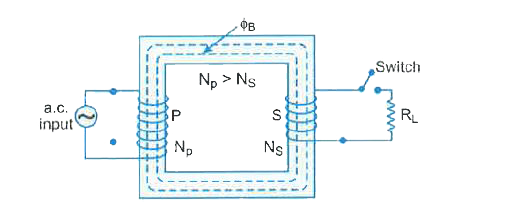
|
|