

Saved Bookmarks
| 1. |
Explaintheoctablralgeometryof complexes usingcrystal fieldtheory. |
Answer» Solution :(1) In an octahedral complex `[MX_(6)]^(n pm)`+, the metal atom or ion is placedat thecentre of regularoctaherdronat sixvertices of theoctahedron. 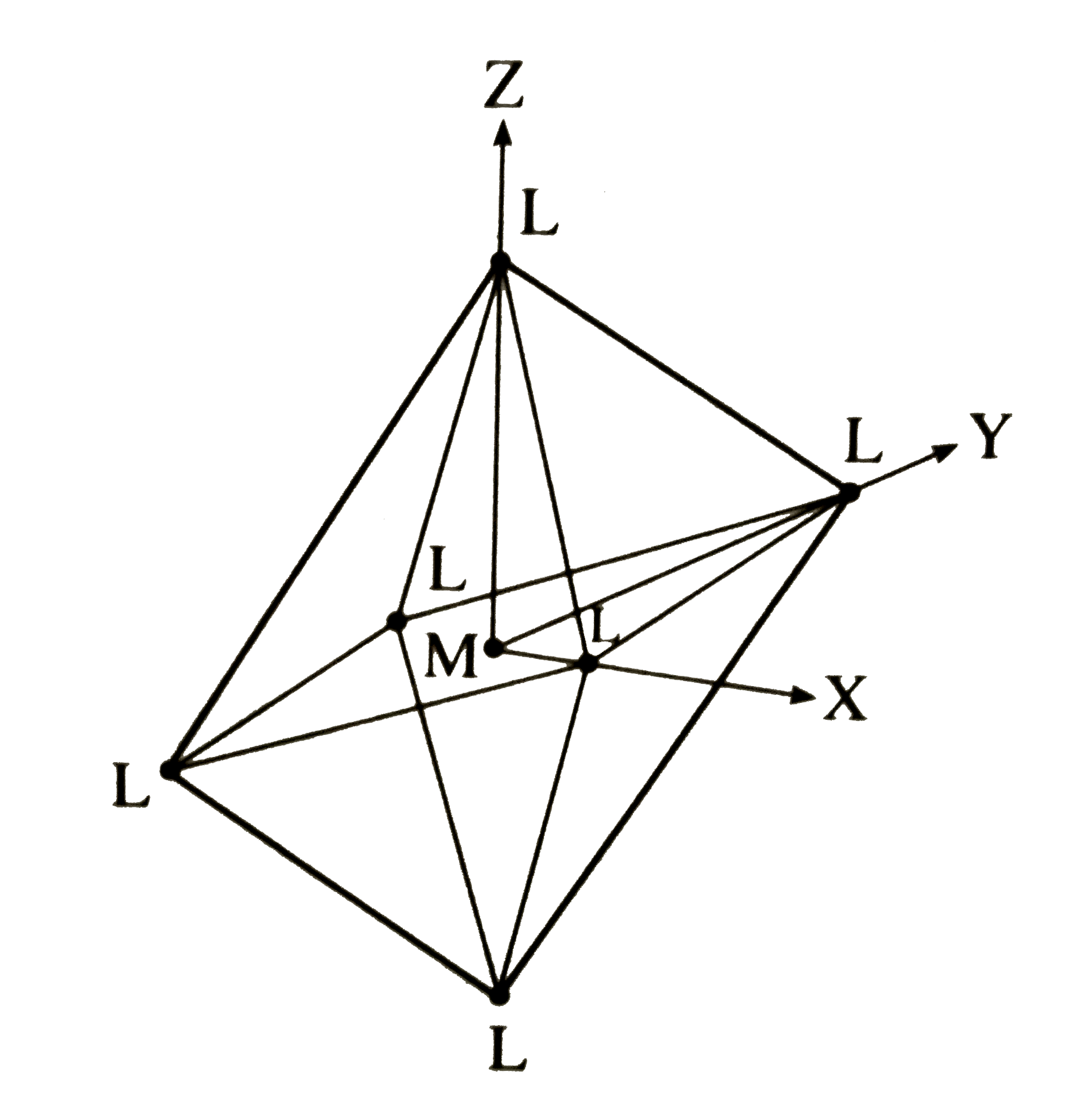 (2) Amongfivedegenerate d-orbitals,TWO orbitalsnamely`d_(X^(2) - y^(2))` and `d_(z^(2))`are axialand havemaximum electron densityalong theaxes, whileremaing three d-oritalsnamely `d_(xy) ,d_(yz) ` and `d_(zx)`are planarand havemaximum electron density in the planes and in- bewteenthe axes. (3) Hence, when the ligands approach a metal ion, the orbitals `d_(x^(2)-y^(2))` and `d_(z^(2))`experience greater repulsion and the orbitals `d_(xy) ,d_(yz) and d_(zx)`experienceless repulsion. (4)Thereforethe energy of `d_(x^(2) - y^(2))` and `d_(z^(3))`increasewhilethe energyof `d_(xy), d_(yz)andd_(zx)`decrease and fived - orbital losedegeneracyand splitinto two pointgroup . Theorbitals`d_(xy), d_(xy) and d_(zx)`form `t_(2g)` groupof lower energywhile `d_(x^(2) - y^(2))` and `d_(z^(2))`form `e_(g)`groupof higherenergy . Thus `t_(2g)`has three degenerate orbitalswhile`e_(g)`hastwo degenerateorbitals. 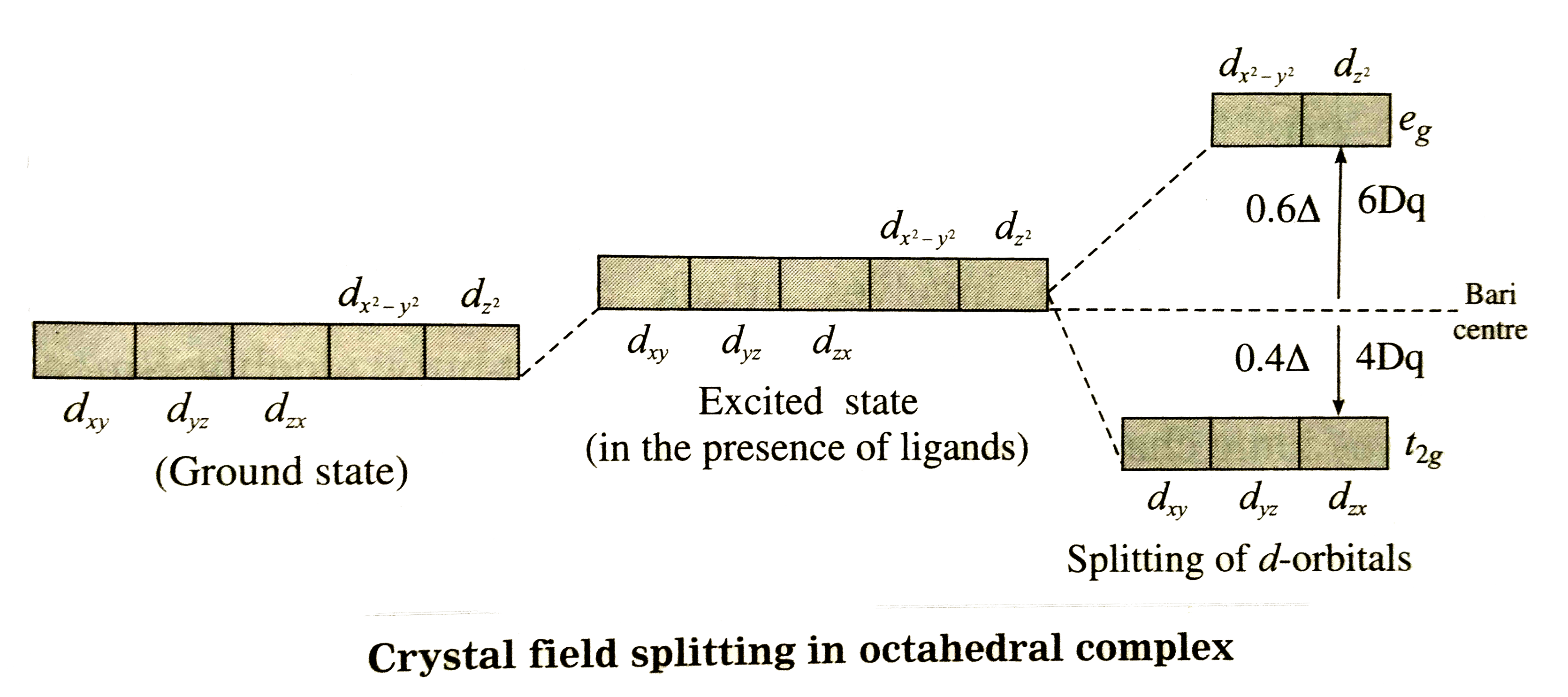 (5) Experimental calculations show that the energy of `t_(2g)` orbitals is lowered by `0.4Delta_(0)` or `4D_(q)` and energy of `e_(g)` orbital is increased by `0.6Delta` or `6D_(q)`. Thus energy difference between ty and eg orbitals is `Delta_(0)` or `10D_(q)` which is crystal field splitting energy. (6)CFSE increases with the INCREASING strength of ligands and oxidation state of central metal ion. |
|