

Saved Bookmarks
| 1. |
Figure 11-16a shows a safe (mass M = 430 kg) hanging by a rope (negligible mass) from a boom (a = 1.9 m and b = 2.5 m) that consists of a uniform hinged beam (m=85 kg) and horizontal cable (negligible mass). What is the tension T_(c) in the cable? In other words, what is the magnitude of the force vecT_(c) on the beam from the cable? |
|
Answer» Solution :The system here is the beam alone, and the forces on it are shown in the free-body diagram. The force from the cable is `vecT_(c)`. The gravitational force on the beam acts at the bcam.s center of MASS (at the heam.s center) and is represented by its equivalent `mvecg`. The vertical component of the force on the beam from the hinge is `vecF_(v)` and the horizontal component of the force from the hinge is `vecF_(h)`. The force from the rope supporting the safe is `vecT_(r)`. Because beam, rope, and safe are stationary, the magnitude of `vecT_(r)` is equal to the weight of the safe: `T_(r) = Mg`. We place the origin O of an xy COORDINATE system at the hinge. Because the system is in static equilibrium, the balancing equations apply to it. calculation: let us start with Eq. 11-27(`tau_("net,z")= 0`) NOTE that we are asked for the magnitude of force `vecT_(c)` and not of forces `vecF_(h)` and `vecF_(v)`acting at the hinge, at point O. To eliminate `vecF_(h)` and `vecF_(v)` from the torque calculation, we should calculate torques about an axis that is perpendicular to the figure at point O. Then `vecF_(h)` and `vecF_(v)` will have moment arms of zero. The lines of action for `vecT_(c)vecT_(r)`, and `mvecg` are dashed. The corresponding moment arms are a, b, and `b//2`. Writing torques in the form of `r_(bot) F` and using our rule about SIGNS for torques, the balancing equation `tau_("net,z")= 0` becomes `(a)(T_(c))-(b)(T_(r))-((1)/(2)b)(mg)=0`(11-29) Substituting Mg for `T_(r)` and solving for `T_(c)` we find that `T_(c)= (gb(M+(1)/(2)m))/(a)` `((9.8 m//s^(2) )(2.5 m)(430 kg +85/2 kg))/(1.9m)` `= 6093 N ~~ 6100 N. ` 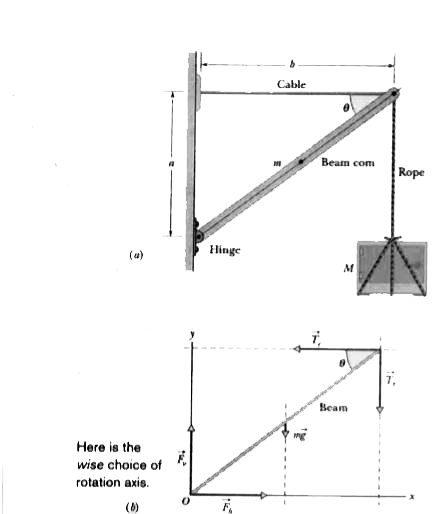
|
|