

Saved Bookmarks
| 1. |
Figure 16-37 shows resonane oscillation of a string of mass m=2.500 g and lengt L= 0.800 m and that is under tension tau= 325.0 N. What is the wavelength lambda of the transverse waves producing the standing wave patient and what is the charmant number. What is the frequency of the transverst waves and of the osciallation of the moving string elements? What is the maximum magnitude of the transverse velocity u_(m) of the element oscillating a coordinate x =0.180 m? At what point during the element's oscillation is the transverse velocity maximum? |
Answer» Solution :(a) The transverse waves that produce STANDING wave pattern must have a wavelength such that inter number n of half-wavelengths fit into the length L of the string. 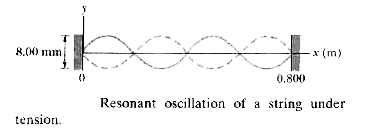 (2) The frequency of those waves and of the oscillations of the string elements is given by Eg. 16-75 `(F=nv//2L).` (3) The displacement of a string element as a function of position X and TIMER is given by Eq, 16-66: `y. (x,t) =[2y_(m) sin kx] cos omega t` Wavelength and harmonic number: In Fig. 16-37, the solid line, which is effectively a snapshot (or freeze-frame) of the oscillations, reveals that 2 full wavelengths fit into the length L=0.800 m of the string. Thus, we have `2lambda=L`, or `lambda=L/2` `=(0.800 m)/(2)=0.400 m` By counting the number of loops (or half-wavelengths) in Fig. 16-37, we see that the harmonic number is n=4 We also find n=4 by comparing Eqs. 16-78 and 16-74 `(lambda = 2L//n).` Thus, the string is oscillating in its FOURTH harmonic. Frequency. We can get the frequency of the transverse waves from Eq. 16.15 `(v= lambda f)` if we first find the speed v of the waves. That speed is given by Eq 16:29, but we must substitute m/L, for the unknown lincar kiensity `MU`. We obtain `v=sqrt(tau/mu)=sqrt(tau/(m//L))=sqrt((tau L)/(m))` `=sqrt((325 N) (0.080 m))/(2.50 xx 10^(-3) kg) =322 .49m//s` After rearranging Eq. 16-15, we write `f=v/lambda=(322.49 m//s)/(0.400m)` =806.2Hz= 806 Hz |
|