

Saved Bookmarks
| 1. |
Figure 27-12 shows a circuit whose elements have the following values: epsi_(1) = 3.0 V, epsi_(2)= 6.0 V, R_1 =2.0 Omega R_2= 2.0Omega. The three batteries are ideal batteries. Find the magnitude and direction of the current in each of the three branches |
|
Answer» Solution :It is not worthwhile to try to simplify this circuit, because no two resistors are in parallel, and the resistors that are in series (those in the right branch or those in the left branch) present no problem. So, our plan is to apply the junction and loop rules. Junction rule: Using arbitrarily chosen directions for the CURRENTS as SHOWN in Fig. 27-12, we apply the junction rule at point a by writing `i_(3)=i_(1)+i_(2)` An application of the junction rule al junction b gives only the same equation, so we next apply the loop rule to any two of the three loops of the circuit. Left-hand loop: We first arbitrarily choose the left-hand loop, arbitrarily start at point b, and arbitrarily traverse the loop in the clockwise direction, obtaining `-i_(1) R_(1)+epsi_(1)-i_(1)R_(1)-(i_(1)+i_(2)) R_(2)-epsi_(2)=0` 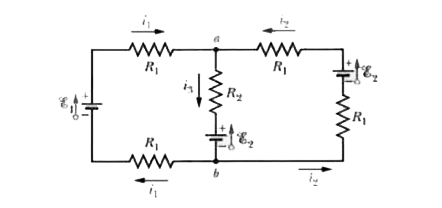 Figure 27-12 A maltiloop circuit with three ideal batteries and five resistances. where we have used `(i_(1)+i_(2))` instead of `i_(3)` in the middle branch. Substituting the given data and simplifying yeild `i_(1) (8.0 OMEGA) +i_(2) (4.0 Omega)=-3.0V` Right-hand loop: For our second application of the loop rule, we arbitrarily choose to traverse the right-hand loop counterclockwise from point b, finding `-i_(2)R_(1)+epsi_(2)-i_(2)R_(1)-(i_(1)+i_(2)) R_(2)-epsi_(2)=0` Substituting the given data and simplifying YIELD `i_(1) (4.0 Omega) +i_(2) (8.0 Omega) =0` Combining equations: We now have system of two equations (Eqs. 27-27 and 27-28) in two unknowns `(i_(1), and i_(2))` to solve either "by hand” (which is easy enough here) or with a "math package." (given in Appendix E.) We find `i_(1)=-0.50A` (The minus sign signals that our arbitrary choice of direction for `i_(1)` in Fig. 27-12 is wrong, but we must wait to correct it.) Substituting `i_(1)=-0.50 A` into Eq. 27-28 and solving for `i_(2),` then give us `i_(2)= 0.25 A.` With Eq. 27-26 we then find that `i_3=i_(1)+i_(2)=-0.50A+0.25 A` The positive answer we obtained for `i_2` signals that our choice of direction for that current is correct. However. the negative answers fort, and indicate that cour choices for those currents are wrong. Thus, as a last ster here, we correct the answers by reversing the arrows for and in Fig, 27-12 and then writing. 20.50 and `i_(1)=0.50 A and i_(3)=0.25 A` Caution: Always make any such correction as the last step and not before valeulaling at the currents. |
|