

Saved Bookmarks
| 1. |
Figure shows a charge array known as an electric quadrupole. For a point on the axis of the quadrupole, obtain the dependence of potential on 'r' for r/a gt gt 1, and contrast your result with that due to an electric dipole, and an electric monopole (i.e, a single charge) |
Answer» Solution :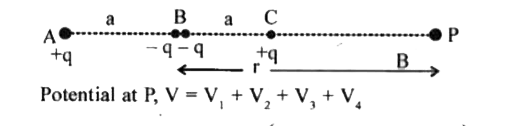 Potential at P, `V=V_(1)+V_(2)+V_(3)+V_(4)` `=(Q)/(4pi epsi_(0)) ((1)/((R+a))-1/r-1/r+(1)/((r-a)))=q/(4pi epsi_(0)) ((1)/((r+a)) -2/r+(1)/((r-a)))` `V=(q)/(4pi epsi_(0)) ((r(r-a)-2(r^(2)-a^(2))+r(r+a))/(r(r-a)(r+a)))=(q)/(4pi epsi_(0)) ((r^(2)-ra-2r^(2)+2a^(2)+r^(2)+ra)/(r(r^(2)-a^(2))))` `=(2q.a^(2))/(4pi epsi_(0) r(r^(2)-a^(2)))=(2q.a^(2))/(4pi epsi_(0) r.a^(2) (r^(2)/a^(2)-1))=(2q)/(4pi epsi_(0) r xx r^(2)/a^(2))=(2q a^(2))/(4pi epsi_(0) r^(3))` V varies for QUADRUPOLE as `1/r^(3)` V varies for DIPOLE as `1/r^(2)` V varies for monopole as `1/r` |
|