

Saved Bookmarks
| 1. |
Figure shows a combination of twelve capacitors each of capacitance C forming a cube . Find the equivalent capacitance of the combination ( a) between the diagonally opposite corners A and B of cube ( b) between the diagonally opposite corners A and D of a face of the cube . |
Answer» Solution :(a) Suppose the charge supplied by the battery is Q . This will be equally divided on the three CAPACITORS connectedto A because on looking from A to B three sides of the CUBE have indentical properties . Hence each capacitor connected to A has charge `(Q)/(3)` . Similarly each capacitor connected to B ALSO has charge `(Q)/(3)` . In the figure ( b) the charges SHOWN are the charges on the capacitors ( i.e charges on their positive plates ) 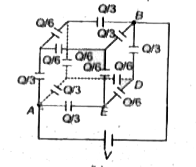 Now `V=(V_(A)-V_(E))+(V_(E)-V_(D))+(V_(D)-V_(B))` `=(Q_(3))/(C)+(Q//6)/(C)+(Q//3)/(C) =(50)/(6C)` `:. C_(eq)=(Q)/(V) = (6)/(5) C` 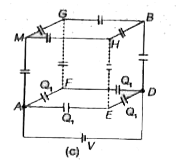 (b) On looking from A to D into the circuit and from D to A into circuit we find symmetry . Henc the charge on each of the four capaitors of the face AEDF is same ( say `Q_(1))` . It means there is no charge on the capacitors between F and G nd between E and H . Hence to find the equivalent capacitance the combination may be taken without these two capacitors which has been shwon in the figure (d). 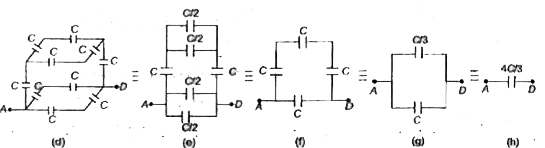
|
|