

Saved Bookmarks
| 1. |
Figure shows an overhead view of two particles moving at constant momentum along horizontal paths. Particle 1, with momentum magnitude p_(1)=5.0kg*m//s, has position vector vecr_(1) and will pass 2.0 m from point O. Particle 2, with momentum magnitude p_(2)=2.0kg*m//s, has position vector vecr_(2) and will pass 4.0 m from point O. What are the magnitude and direction of the net angular momentum vecL about point O of the two particle system? |
|
Answer» <P> Solution :To find `vecL`, we can first find the individual angular momenta `vecl_(1)andvecl_(2)` and then add them. To evaluate their magnitudes, we can use any one of EQS. Through. HOWEVER, Eq. is easiest, because we are given the perpendicular distances `r_(bot1)(=2.0m)andr_(BOT2)(=4.0m)` and the momentum magnitudes `p_(1)andp_(2)`.Calculations: For particle 1, Eq. yields `l_(1)=r_(bot1)p_(1)=(2.0)(5.0kg*m//s)` = `10kg*m^(2)//s`. To find the direction of vector `vecl_(1)`, we use Eq. and the right-hand rule for vector products. For `vecr_(1)xxvecp_(1)`, the vector product is out of the page, perpendicular to the plane of Fig. This is the positive direction, consistent with the counterclockwise rotation of the particle.s position vector `vecr_(1)` around O as particle 1 moves. Thus, the angular momentum vector for particle 1 is `l_(1)=+10kg*m^(2)//s`. 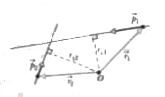 Similarly, the magnitude of `vecl_(2)` is `l=r_(bot2)p_(2)=(4.0m)(2.0kg*m//s)` = `8.0kg*m^(2)//s`, and the vector product `vecr_(2)xxvecp_(2)` is into the page, which is the negative direction, consistent with the clockwise rotation momentum vector for particle 2 is `l_(2)=-8.0kg*m^(2)//s` The net angular momentum for the two particle system is `L=l_(1)+l_(2)=+10kg*m^(2)//s+(-8.0kg*m^(2)//s)` = `+2.0kg*m^(2)//s`. |
|