

Saved Bookmarks
| 1. |
Figure shows the motion of a particle along a straight line. Find the average velocity of the particle during the intervals (a)A to E , (b) B to E, (c ) C to E, (d) D to E , (e) C to D . |
Answer» SOLUTION :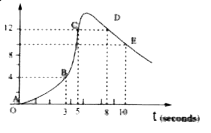 (a) As the particle moves from A to E, A is the initial point and E is the final point. The slope of the line drawn from A to E i.e., `(Deltax)/(Deltat)`gives the average velocity during that INTERVAL of time . The displacement `Deltax` is `X_E-X_A` = 10 cm -0 cm =+10 cm The time interval `Deltat_(EA)=t_E-t_A` =10 s . `therefore` During this interval average velocity `barv=(Deltax)/(Deltat)=(+10cm)/(10s)=+1cms^(-1)` (B)During the interval B to E, the displacement `Deltax=x_E-x_B`=10 cm -4 cm =6 cm and `Deltat=t_E-t_B` =10s -3 s =7s `therefore` Average velocity `barv=(Deltax)/(Deltat)=(6CM)/(7s)` `=+0.857 cms^(-1) = 0.86 cms^(-1)` (c) During the interval C to E , the displacement `Deltax=x_E-x_C` = 10 cm -12 cm =2 cm and `Deltat=t_E-t_C` =10s - 5s =5s `therefore barv=(Deltax)/(Deltat)=(-2cm)/(5s)=-0.4cms^(-1)` (d)During the interval D to E , the displacement `Deltax=x_E-x_D` = 10 cm -12 cm =-2cm and the time interval `Deltat=t_E-t_D` =10s -8s =2s `therefore barv=(Deltax)/(Deltat)=(-2cm)/(2s)=-1cms^(-1)` (e)During the interval C to D, the displacement `Deltax=x_D-x_C` = 12cm -12cm =0 and the time interval `Deltat=t_D-t_C` =8s -5s =3s `therefore` The average velocity `barv=(Deltax)/(Deltat)=(0m)/(3s)=0 MS^(-1)` (The particle has reached the same position during these 3s. The average velocity is zero because the displacement is zero). |
|