

Saved Bookmarks
| 1. |
Figure shows tracks of three charged particles in a uniform electrostatic field. Give the signs of the three charges. Which particles has the highest charge to mass ratio ? (a) Suppose two particles have identical curved trajectories true ? (i) they have same charge (ii), they have same charge mass (iii) the charges have the same sign. (iv) they have the same e//m ration. (b) you are given the initial velocity vof a beam particale and the lengthof the capacitor l. What other measurement would enable one to finde//m ? |
|
Answer» Solution :The charge on particles `1 and 2` , must be negativeand charge on particle `3` MUSTBE positive. We shallshow that chargeto mass ration `(e//m)` is highest in case of particale `3`. If we assume that the three charged particles haveeneteredthe electricfield with the same velocity, thenthe deflection is proportional to `(e//m)` of this particale must be the highest. (a) Whentwo particles have identicalcurvedtrajectories, theirchargesmust have the samesign and the particlesmust havethe same `e//m` ration. (b) if h is the vertical DISPLACEMENT of particle at the end of capacitorplatesas shownin Figure then, from 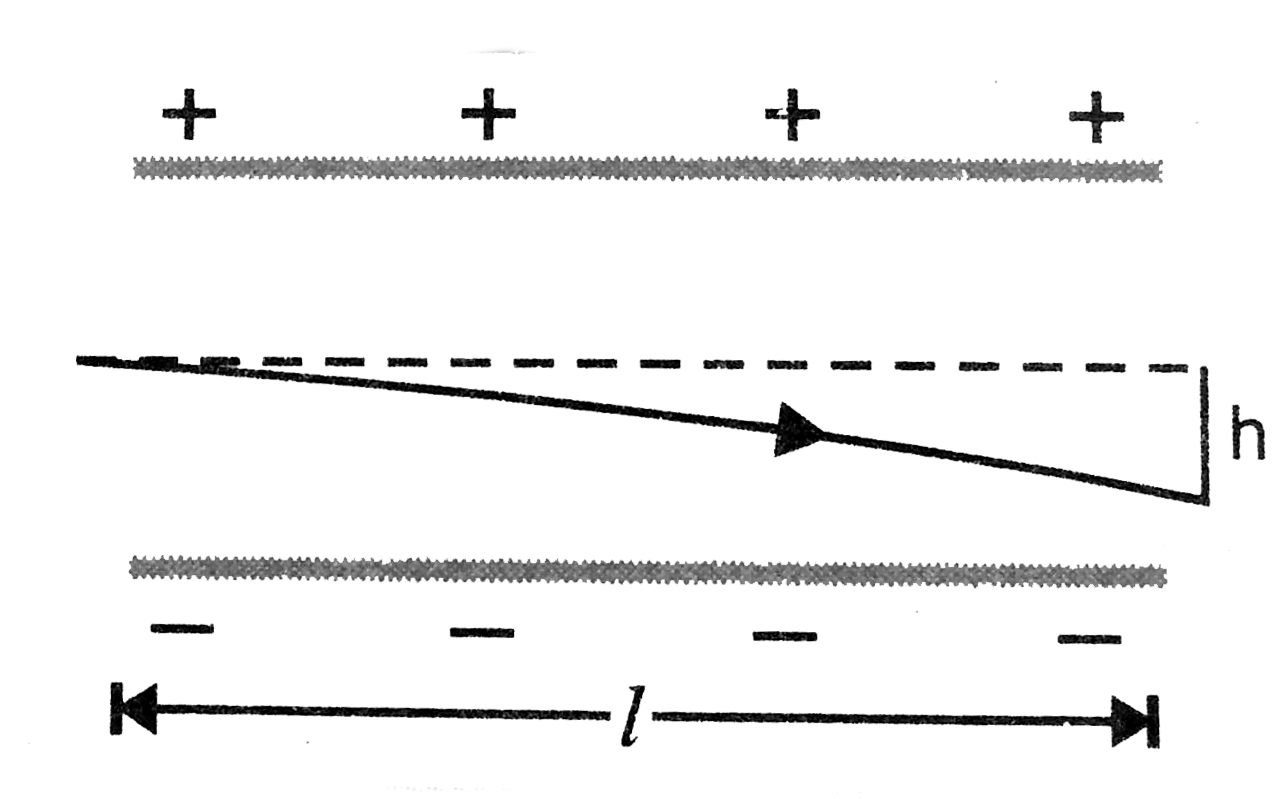 `s = ut + (1)/(2) at^(2)` `h = 0 + (1)/(2) ((eE)/(m)) ((l)/(v))^(2) = (1)/(2) ((e)/(m)) (El^(2))/(v^(2))` `e//m = (2V^(2)h)/(E l^(2))` As E, l and v are known, by MEASURING h, we cancalculate`(e//m)`. The relation shws that for given `E, l and v ,` deflection `(h) prop (e//m)`. This is what we have stated above. |
|