

Saved Bookmarks
| 1. |
Figure8-5a shows two industrial spies sliding an initially stationary 225 kg floor safe a displacement vec(d) of magnitude 8.50 m. The push vec(F)_(1) of spy001 is 12.0 N at an angle of 30.0^(@) downward from the horizontal, the pull vec(F)_(2) of spy 002 is 10.0 N at 40.0^(@) above the horizontal. The magnitudes and directions of these forces do not change as the safe moves, and the floor and safe make frictionless contact. (a) What is the net work done on the safe by forces vec(F)_(1) and vec(F)_(2) during the displacement vec(d) ? |
|
Answer» Solution :KEY IDEAS the net work W DONE on the safe by the two forces is the sum of the works they do individually. (2) Because we can treat the safe as a particle and the forces are constant in both magnitude and direction, we can use either Eq. `8-7 ( W = Fd cos phi) "or Eq." 8-8(W=VEC(F)*vec(d))` to CALCULATE those works. Let.s choose Eq. 8-7. Calculations: From Eq. 8-7 and the free-body diagram for the safe in Fig. 8-5b, the work done by `vec(F)_(1)` is `W_(1)=F_(1)d cos phi_(1)=(12.0N)(8.50m)(cos 30.0^(@))` `=88.33J`, and the work done by `vec(F)_(2)` is `W_(2)=F_(2)d cos phi_(2)=(10.0N)(8.50m)(cos40.0^(@))` `=65.11J`. Thus, the net work W is `W=W_(1)+W_(2)=88.33J+65.11J` `=153.4J~~153J`. During the 8.50 m displacement, therefore, the spies transfer 153 J of energy to the kinetic energy of the safe. 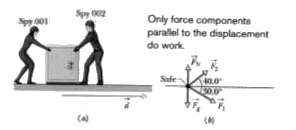 FIGURE 8-5 (a) Two spies MOVE a floor safe through a displacement `vec(d)` (b) A free-body diagram for the safe. |
|