

Saved Bookmarks
| 1. |
Find magnitude and direction of magnetic field at point P in the following cases. (a) (b) P is the centre of square. (c) P is the centre of equilateral triangle. (d) P is the centre of regular hexagon. (e) P is the centre of rectangular loop. (f) (g) A long wire carrying a current i is bent to from a plane angle theta. Find magnetic field at a point on the bisector of this angle is situated at a distance d from vertex. (h) A long, straight wire carriers a current i. Let B_(1) be the magnetic field at a point P at a distance d from the wire. consider a section of length l of this wire such that the point P lies on a perpendicular bisector of the sector. Let B_(2) be the magnetic field at this point due to this section only. find the value of d//l so that B_(2) differes from B_(1) by 1%. |
Answer» Solution :(a) 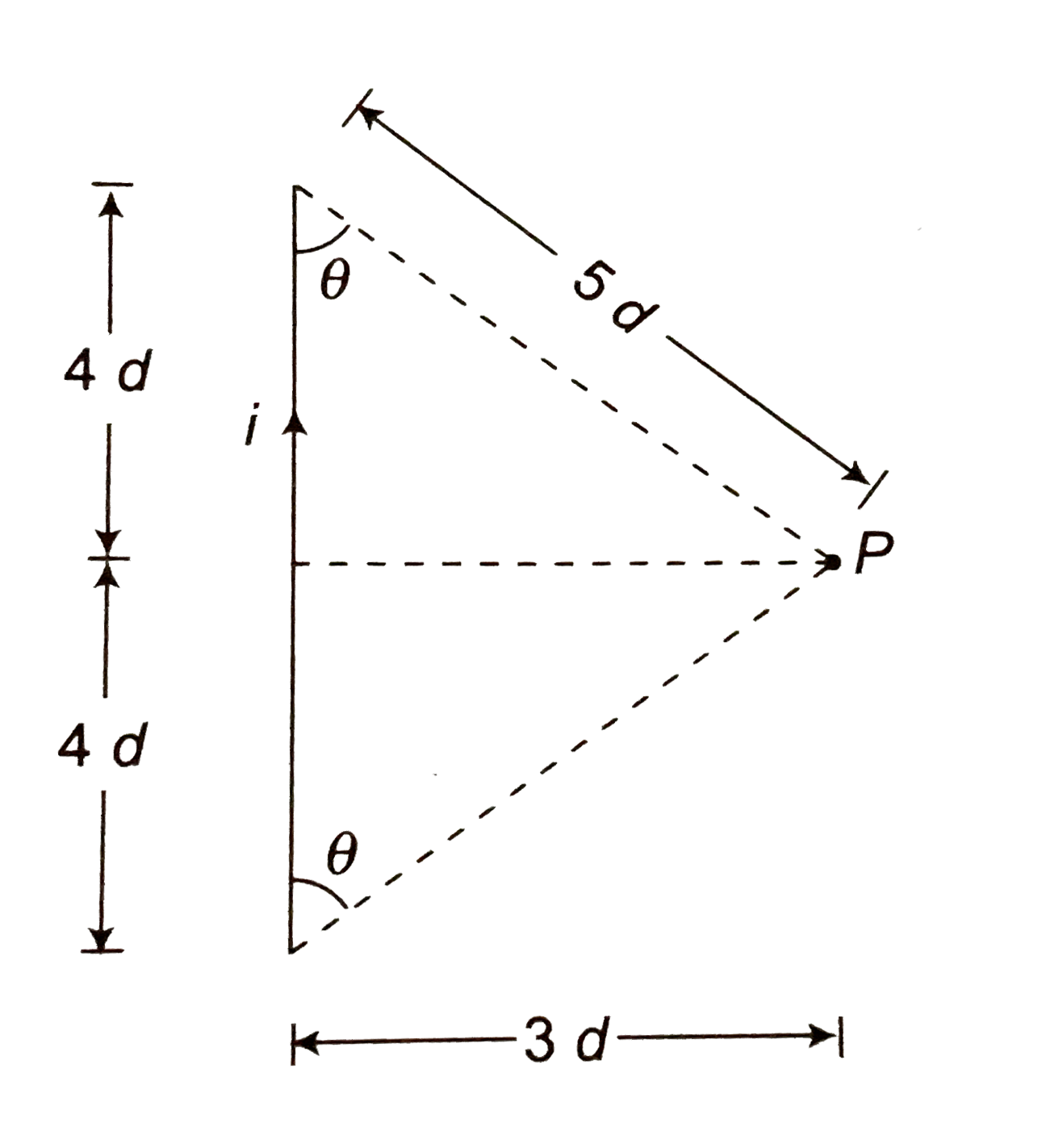 `B_(P)=(mu_(0)i)/(4pid')[cos theta_(1)+cos theta_(2)]` `=(mu_(0)i)/(4pi(3d))[cos theta+cos theta]` `=(mu_(0)i)/(6pid) cos theta` `cos theta=4/5` `B_(P)=(mu_(0)i)/(6pid) .4/5=(2mu_(0)i)/(15pid) ox`. (b) 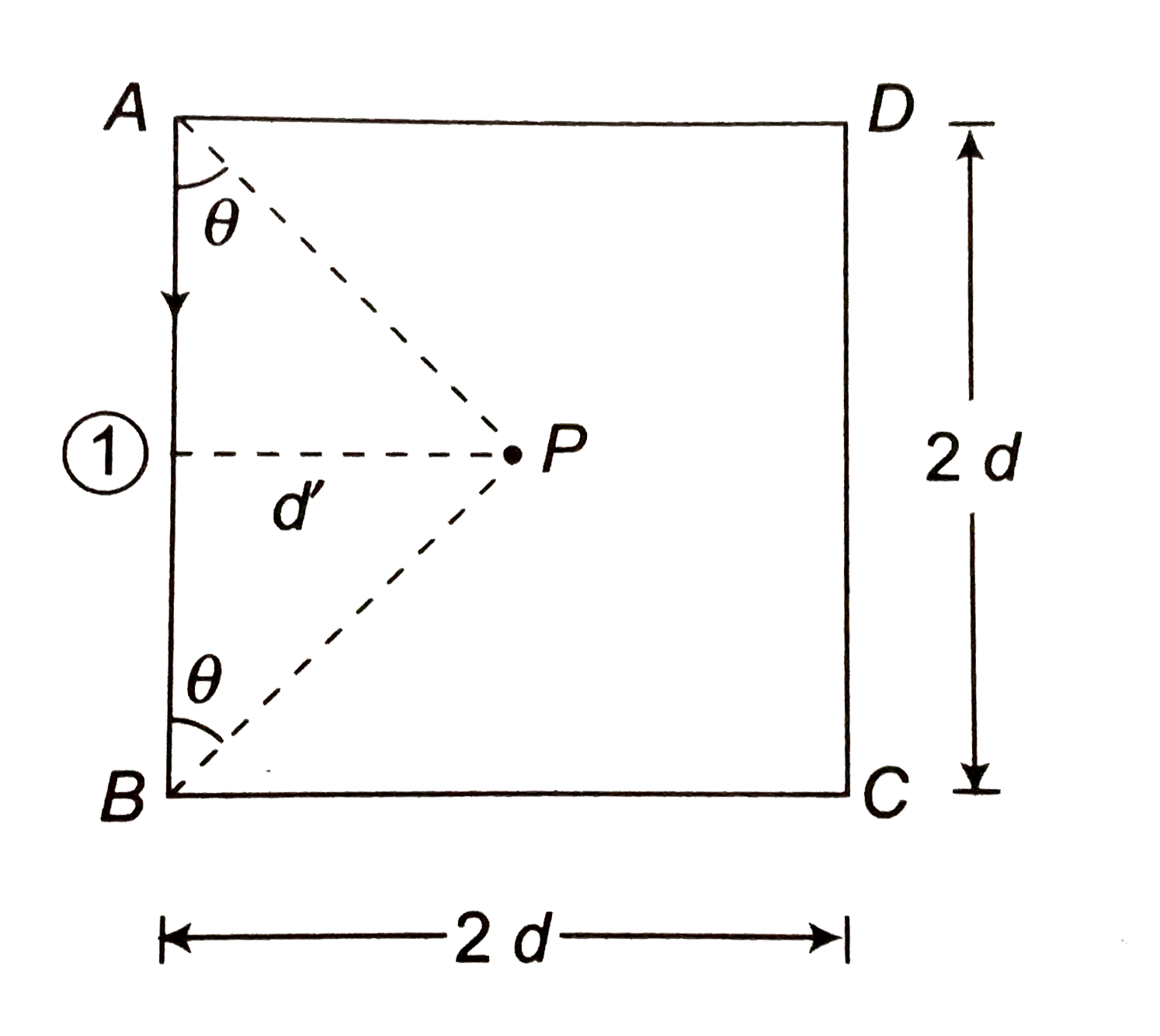 Magnetic field at `P` DUE to one side of SQUARE, say `AB` `B_(1)=(mu_(0)i)/(4pid')(cos theta+cos theta)` `d'=d, theta=45^(@)` `=(mu_(0)i)/(4pid).2.(1)/(sqrt(2))=(mu_(0)i)/(2sqrt(2)pid)` Magnetic field due to square loop `B_(p) = 4B_(1) = (sqrt2mu_(0)i)/(pi d)` Since current anticlockwise, magnetic field at `P` will be outside the plane of paper. `B_(P)=(sqrt(2)mu_(0)i)/(pid), o.` (c) 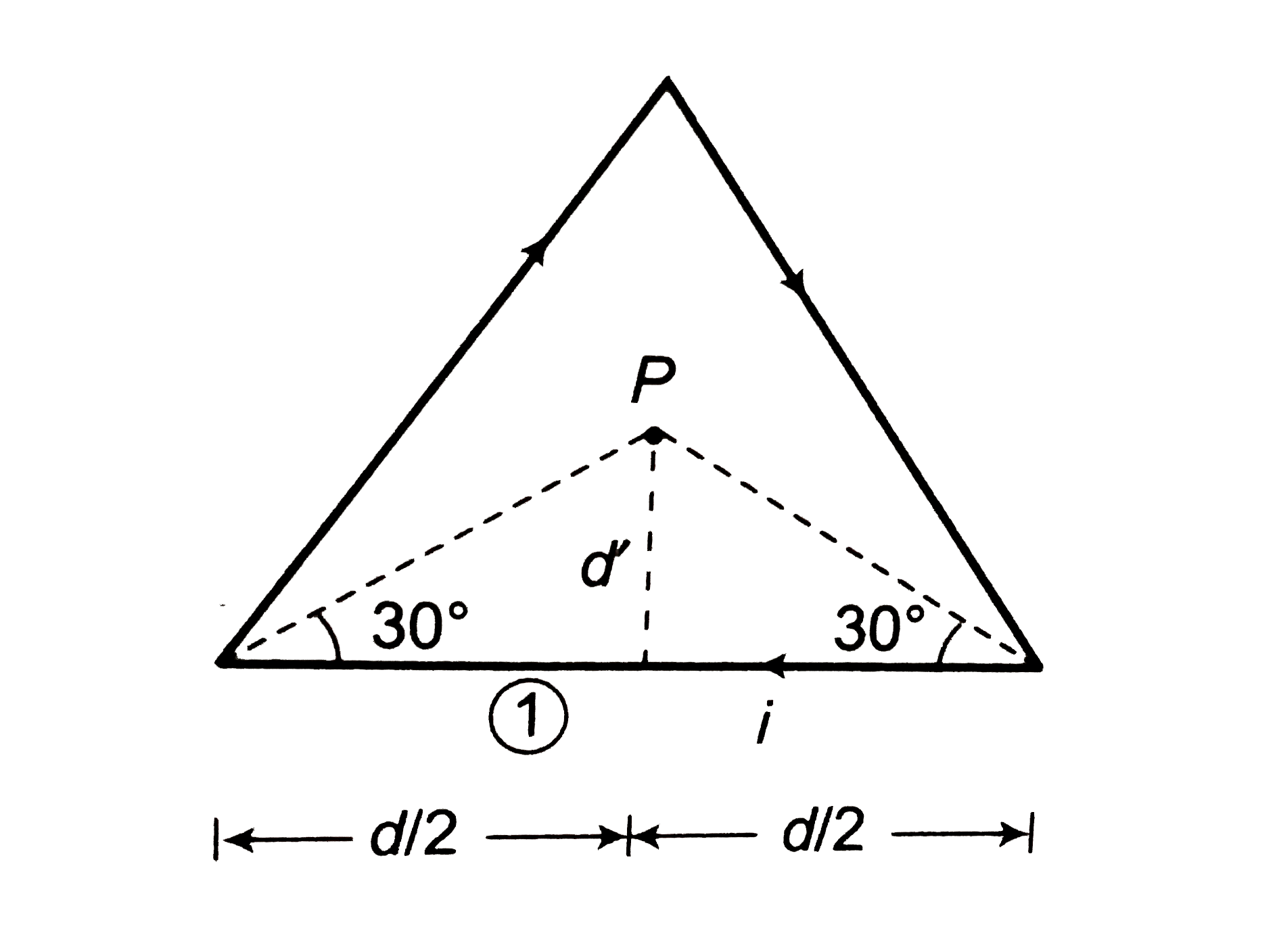 `tan 30^(@) =(d')/(d//2) implies d'=d/(2sqrt(3))` `theta_(1)=theta_(2)=30^(@)` `B_(1)=(mu_(0)i)/(4pid')[cos30^(@)+cos30^(@)]` `=(mu_(0)i)/(4pi.d/(2sqrt(3))).2 (sqrt(3))/2=(3mu_(0)i)/(2pid)` Magnetic field at `P` due to triangular loop `B_(P)=3B_(1)=(9mu_(0)i)/(2pid)` Since current is clockwise, magnetic field at `P` inside the plane of paper. `B_(p)=(9mu_(0)i)/(2pid)` Since current is clockwise, magnetic field at `P` inside the plane of paper. `B_(p)=(9mu_(0)i)/(2pid), ox` (d) 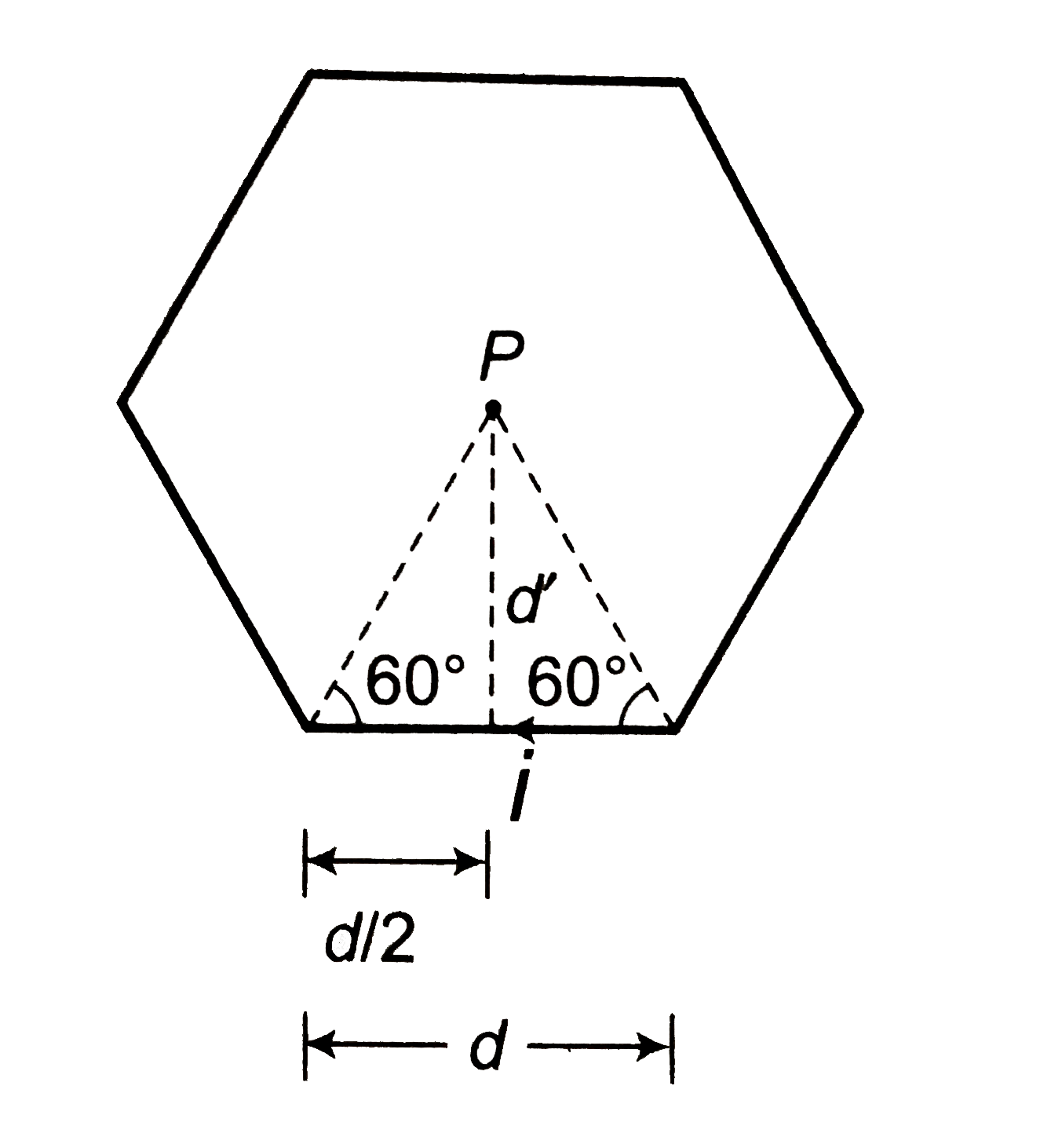 `B_(1)=(mu_(0)i)/(4pid')(cos 60^(@)+cos 60^(@))` `=(mu_(0)i)/(4pi.d/2tan 60^(@)).2 cos 60^(@)` `=(mu_(0)i)/(2pidsqrt(3))` `B_(P)=6B_(1)=(sqrt(3)mu_(0)i)/(pid), ox` (e) 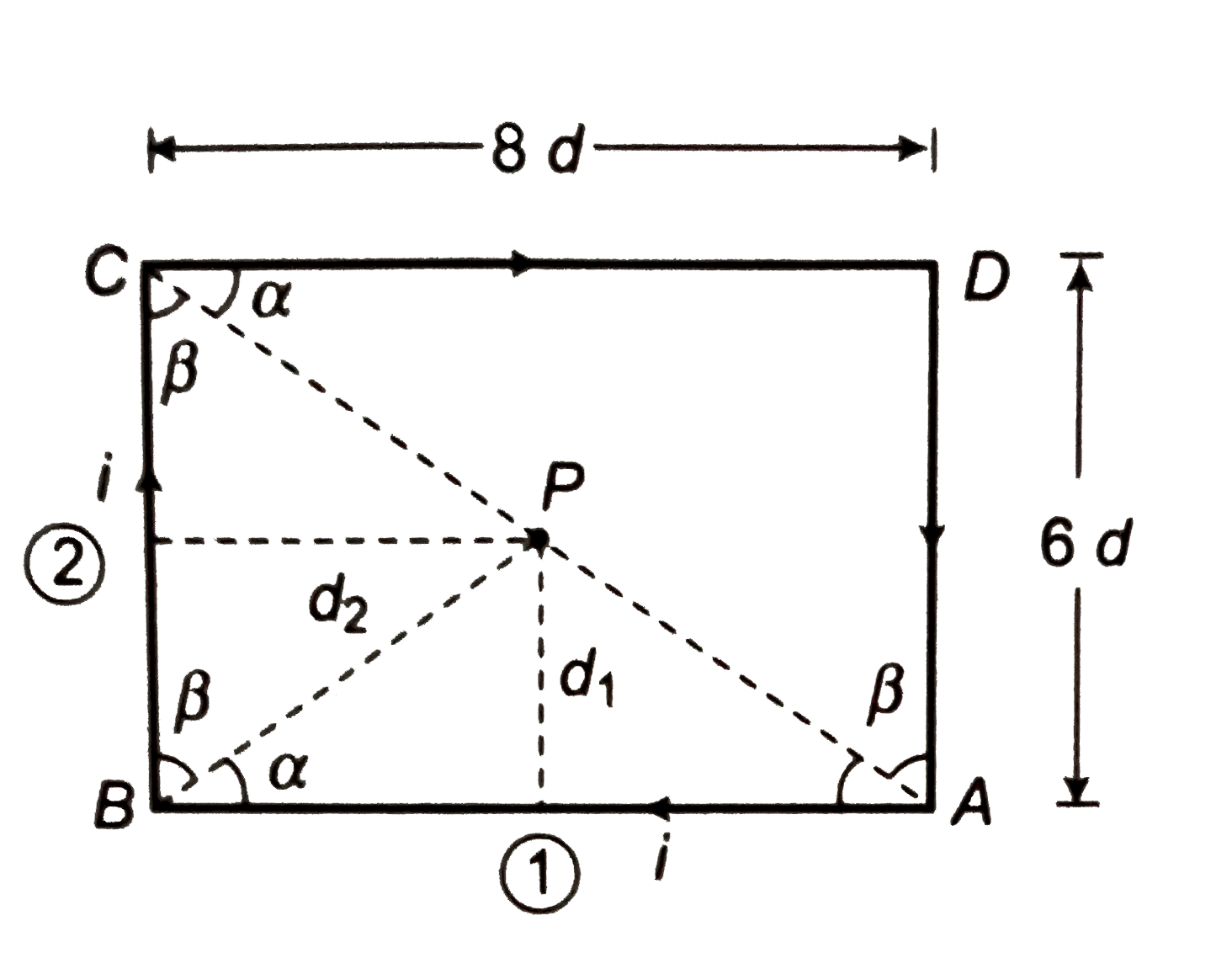 From `TRIANGLEADC,AC=10d` `cos alpha =(8D)/(10d)=4/5, cos beta=(6d)/(10d)=3/5` `d_(1)=3d, d_(2)=4d` `B_(1)=(mu_(0)i)/(4pid_(1))(cos alpha+cos alpha)` `=(mu_(0)i)/(4pi.3d)xx2xx4/5=(2mu_(0)i)/(15pid)` `B_(2)=(mu_(0)i)/(4pid_(2))(cos beta+cos beta)` `=(mu_(0)i)/(4pi.4d)xx2xx3/5=(3mu_(0)i)/(40pid)` `B_(P)=2(B_(1)+B_(2))=2((2mu_(0)i)/(15pid)+(3mu_(0)i)/(40pid))` `=(2mu_(0)i)/(pid)(2/15+3/40=(16+9)/120)` `=(5mu_(0)i)/(12pid), ox` (f) 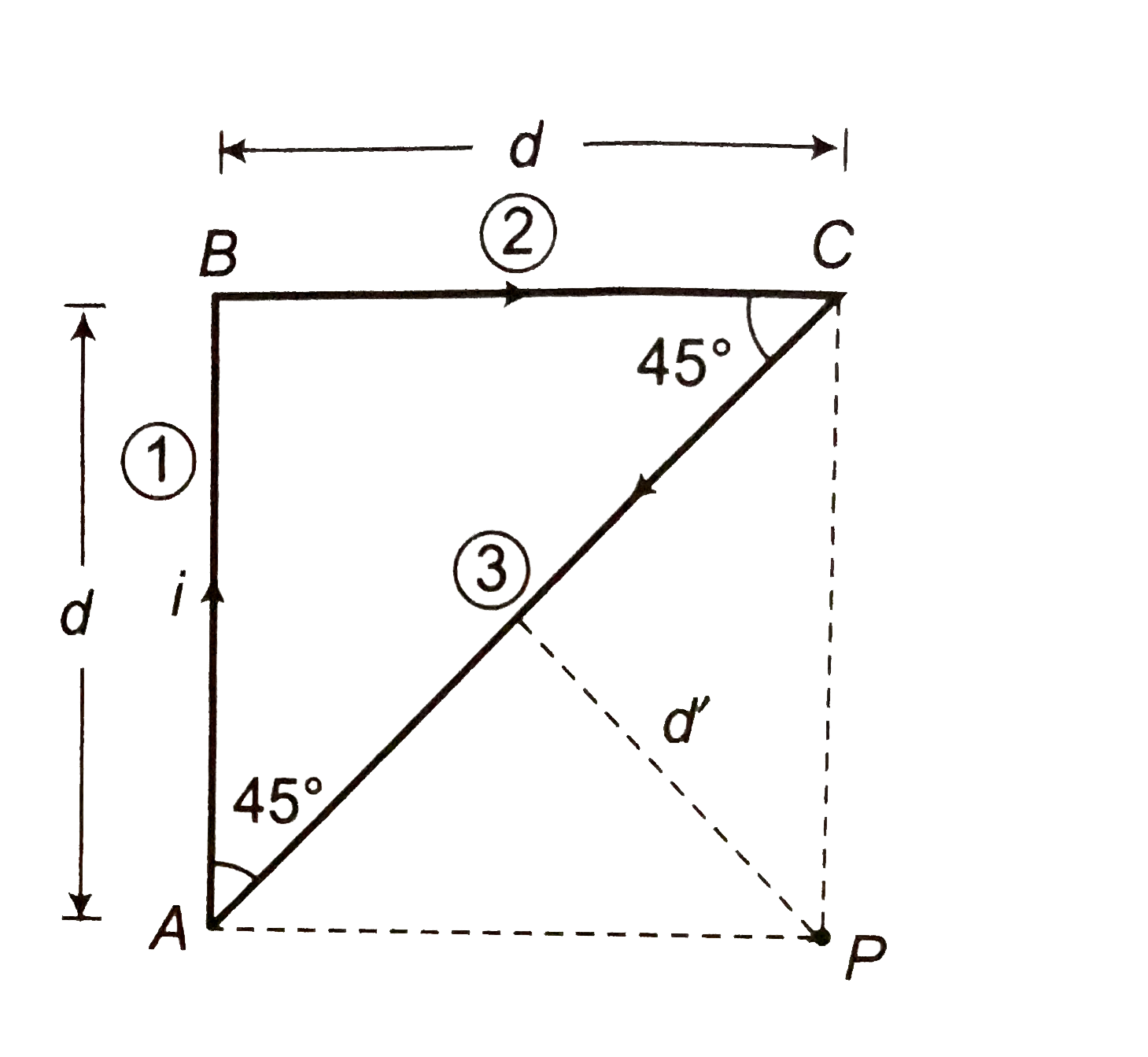 Magnetic field at `P` Due to `AB:` 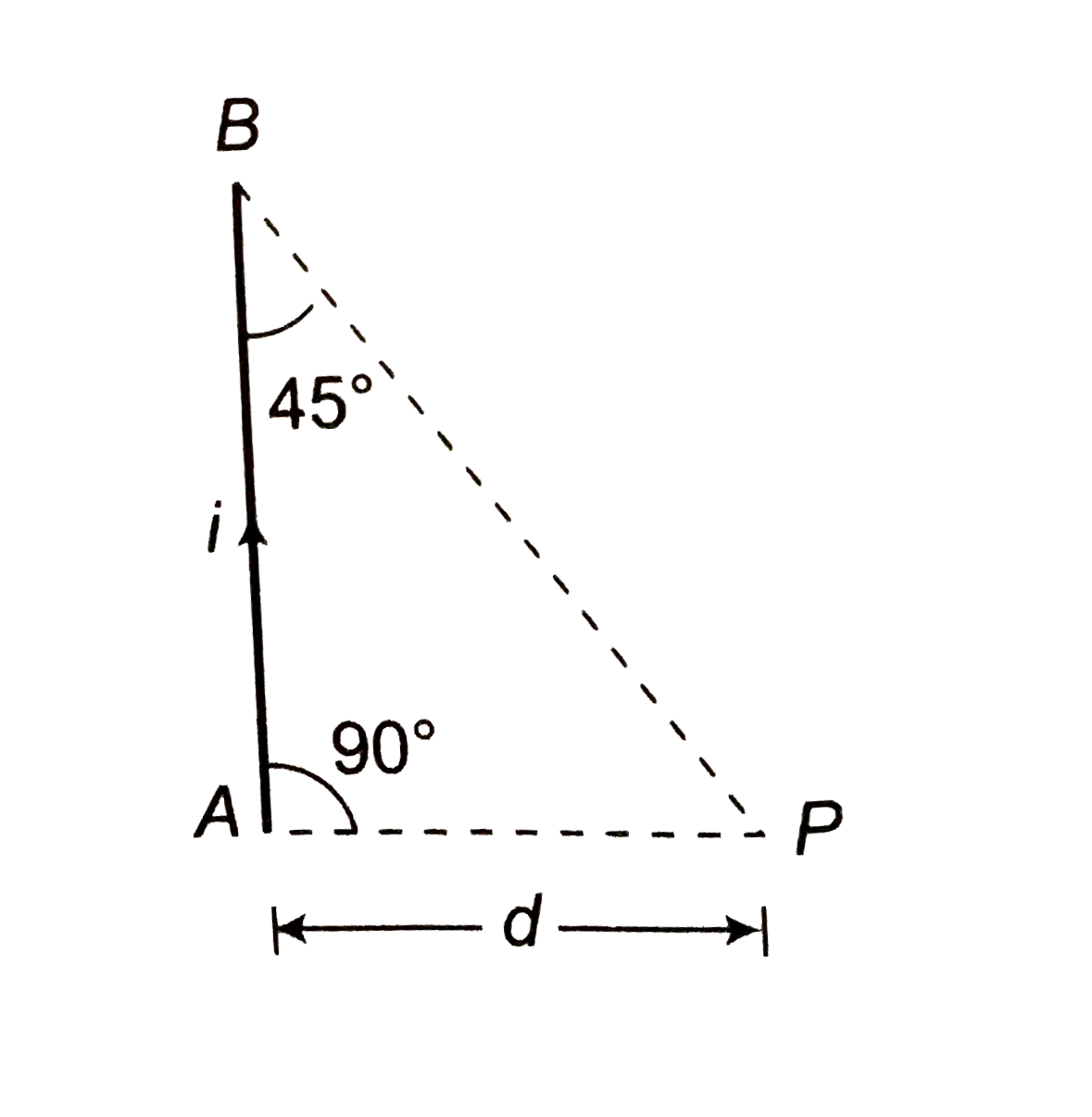 `B_(1)=(mu_(0)i)/(4pid_(2))(cos 90^(@)+cos 45^(@))` `=(mu_(0)i)/(4sqrt(2)pid), ox` Due to `BC` 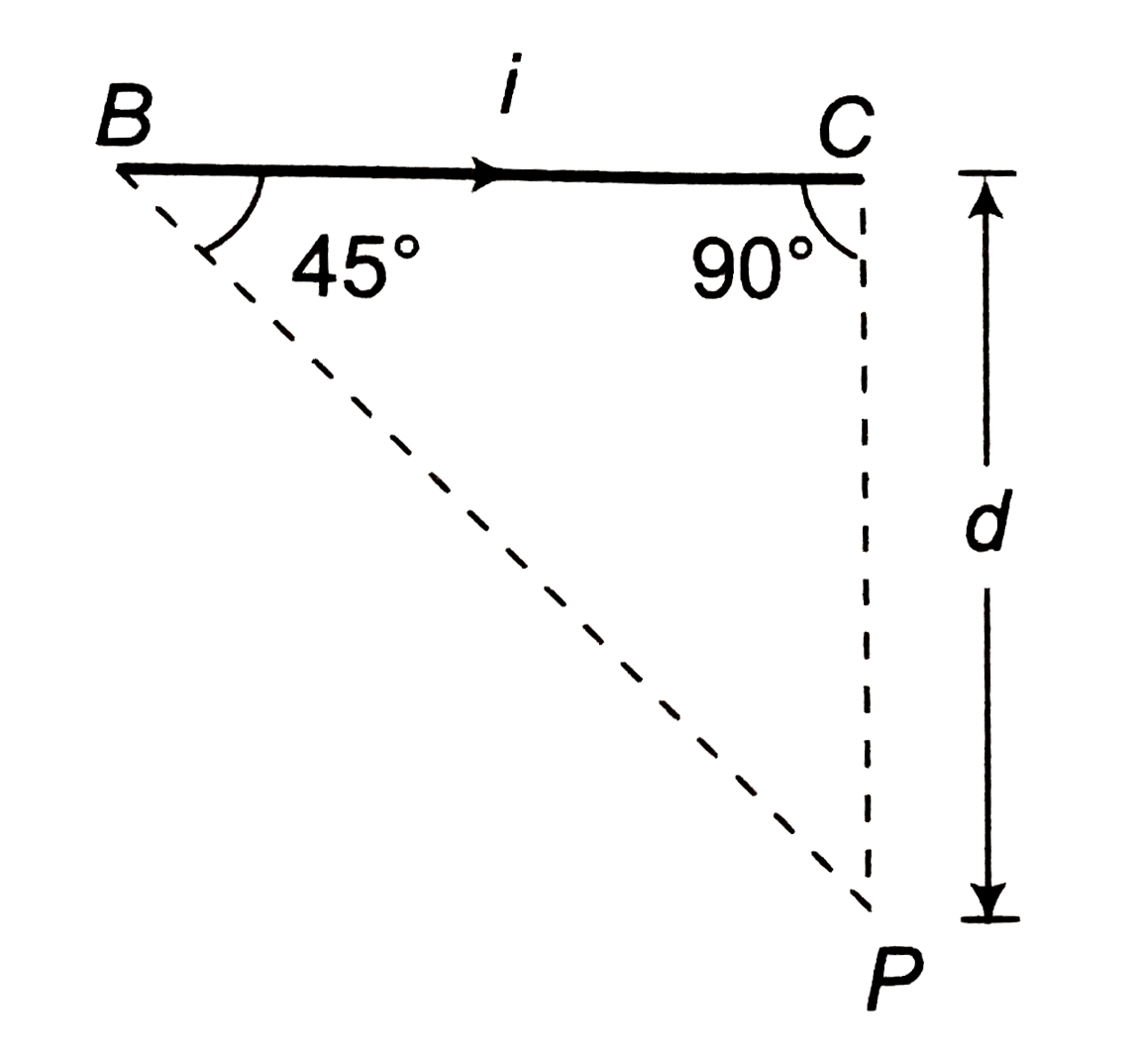 `B_(2)=(mu_(0)i)/(4pid_(2))(cos 45^(@)+cos 90^(@))` `=(mu_(0)i)/(4sqrt(2)pid), ox` Due to `CA` 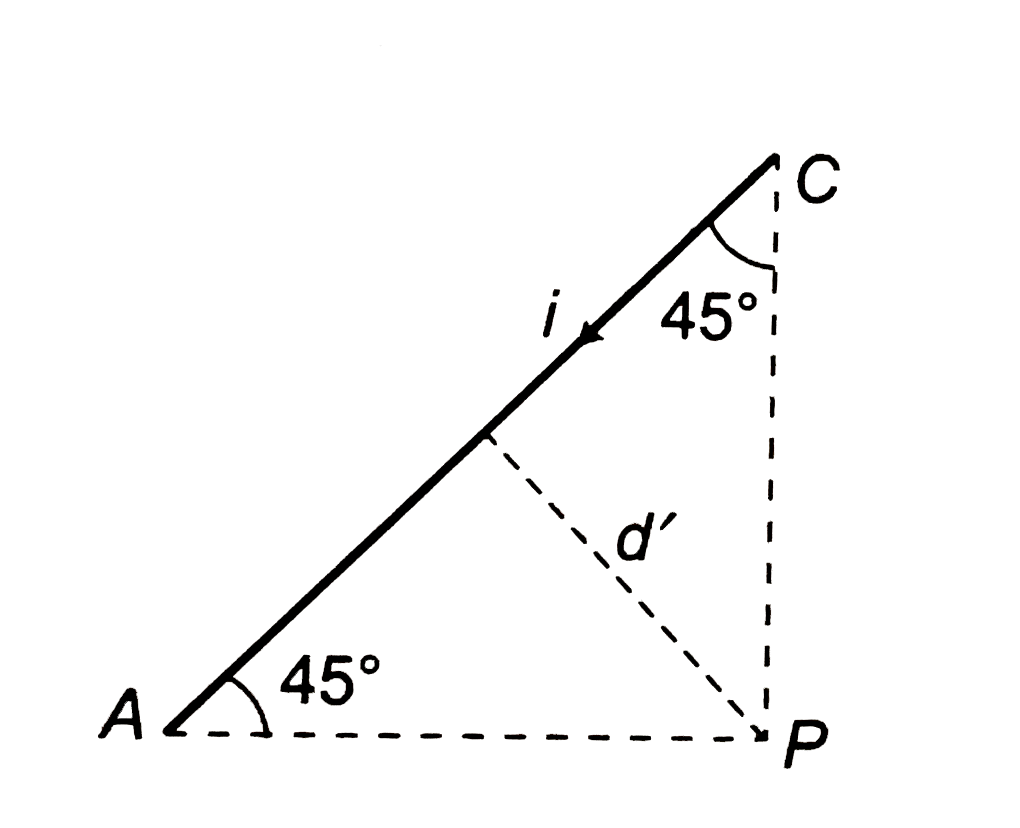 `B_(3)=(mu_(0)i)/(4pid')(cos 45^(@)+cos 45^(@))` `=(mu_(0)i)/(4pi.d/(sqrt(2)))xx2xx1/(sqrt(2))=(mu_(0)i)/(2pid), o.` `B_(3)gt(B_(1)+B_(2))` `B_(P)=B_(3)-(B_(1)+B_(2))` `=(mu_(0)i)/(2pid)-(mu_(0)i)/(2sqrt(2)pid)=(mu_(0)i)/(4pid)(2-sqrt(2)), o.` (g) 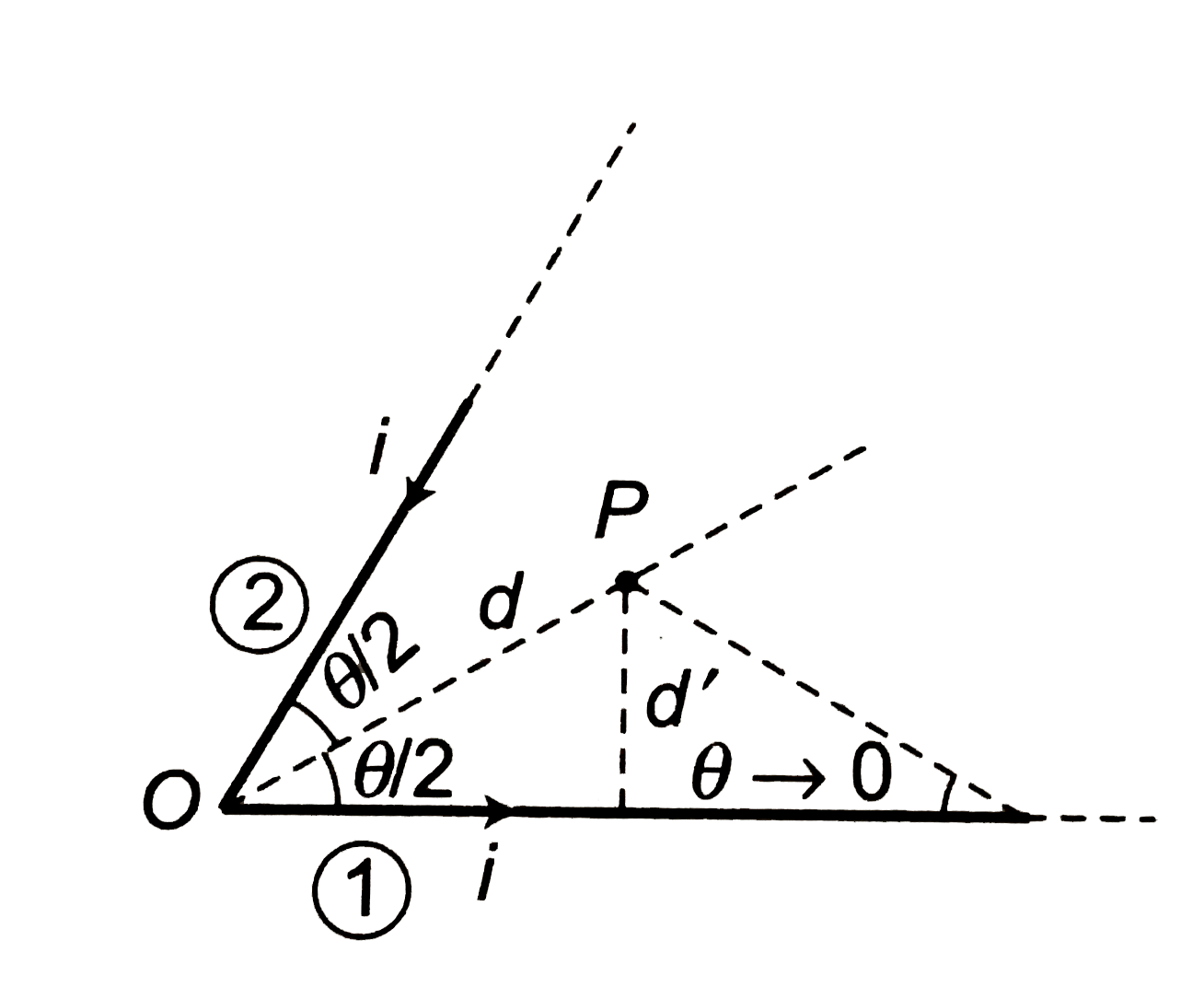 `d'=d sin.(theta)/(2)` `B_(1)=(mu_(0)i)/(4pid')(cos. (theta)/(2)+cos 0)` `=(mu_(0)i)/(4pid sin.(theta)/(2))(1+cos.(theta)/(2))` `=(mu_(0)i)/(4pid(2sin.(theta)/(4)cos.(theta)/(4)))(1+2cos^(2).(theta)/(4)-1)` `=(mu_(0)i)/(4pid)cot.(theta)/(4)=B_(2), o.` `B_(P)=B_(1)+B_(2)=2B_(1)` `=(mu_(0)i)/(2pid)cot.(theta)/(4), o.` (H) 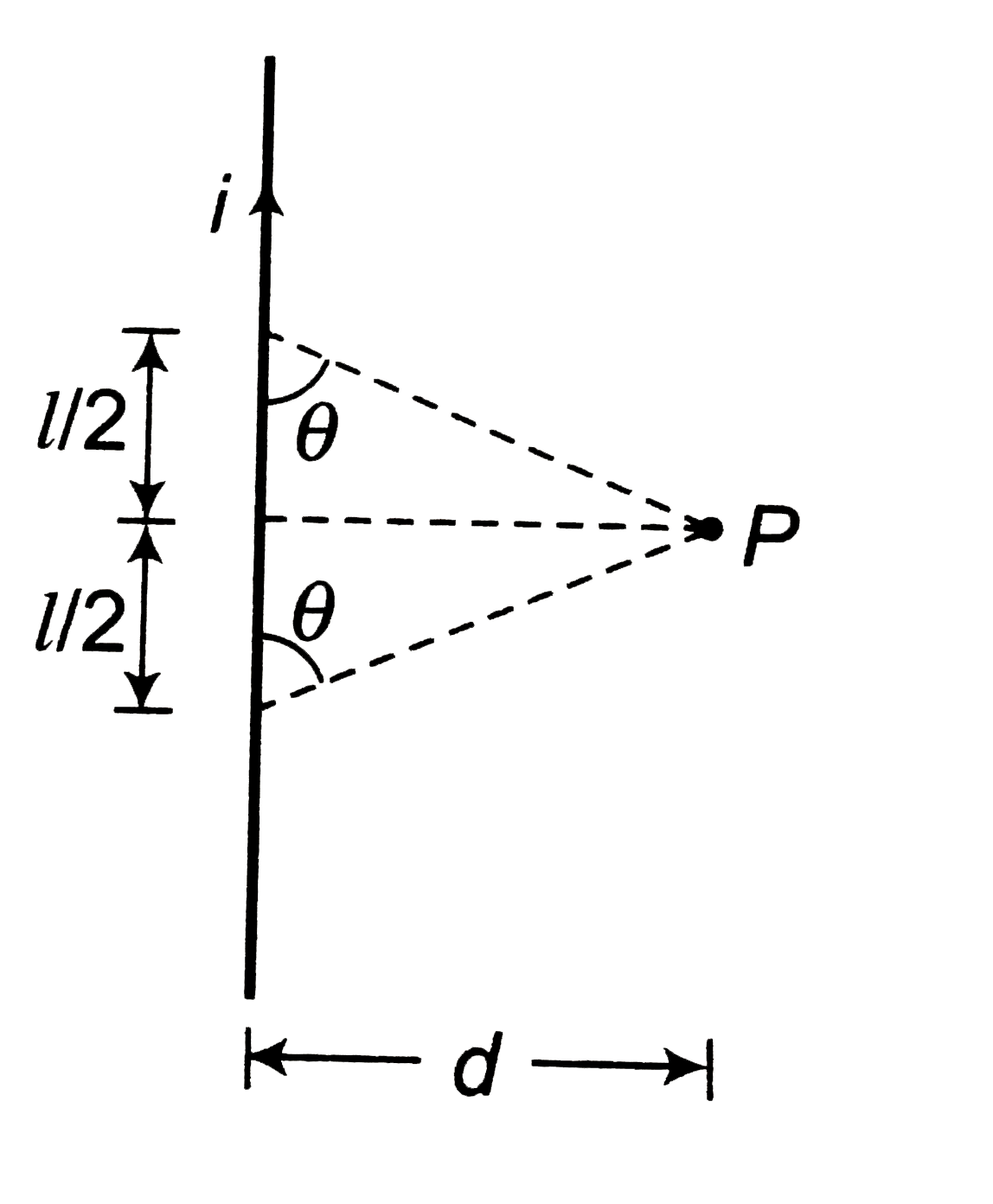 `B_(1)=(mu_(0)i)/(2pid)` `B_(2)=(mu_(0)i)/(4pid)(cos theta+cos theta)` `cos theta=(l//2)/(sqrt((l//2)^(2)+d^(2))) = l/(sqrt(l^(2)+4d^(2)))` `B_(1)gtB_(2)` `B_(1)-B_(2)=1/100B_(1)` `99/100 B_(1)=B_(2)` `99/100xx(mu_(0)i)/(2pid)=(mu_(0)i)/(4pid)xx2xxl/(sqrt(l^(2)+4d^(2)))` `(99)sqrt(l^(2)+4d^(2))=100l` `(99)^(2)(l^(2)+4d^(2))=(100^(2))l^(2)` `(99)^(2)4d^(2)=(100^(2)-99^(2))l^(2)` `(d^(2))/(l^(2))=((199)(1))/((99)^(2)xx4)` `d/l=0.07` |
|