

Saved Bookmarks
| 1. |
Find the expression for the potential energy of a system of two point charges q_(1), and q_(2) glocated at vecr_(1) and vecr_(2) respectively in an external electric field vecE. (b) Draw equipotential surfaces due to an isolated point charge (-q) and depict the electric field lines. (c) Three point charges +1muC,-1 muC and +2muC are initially infinite distance apart. Calculate the work done in assembling these charges at the vertices of an equilateral triangle of side 10 cm. |
|
Answer» Solution :(a) To find the potential energy of a system of two point CHARGES `vecr_(1) and vecr_(2)` situated at points and respectively in an external electric field `VECE`, first we calculate the work done in bringing the charge `q_(1)`. from infinity to `vecr_(1)`. Work done in this step is `W_1=q_1V(vecr_(1))," where "V(vecr_1)` is the electrostatic potential at `vecr_(1)`. Now we consider the work done in bringing `q_(2)" to "vecr_(2)`. In this step work W, is done against the electric field and work `W_2` is done against the field due to charge `q_1.` Obviously `W_(2)=q_(2)V(vecr_(2))," where "V(vecr_(2))` is the electrostatic potential at `vecr_(2)` and `W_(12)=(q_(1)q_(2))/(4pi epsi_(0).r_(12)) "where "r_(12)=|vecr_(1)-vecr_(2)|` = distance between `q_(1) and q_2` Total work done in bringing `q_(2)" to "vecr_(2)=W_(2)+W_(12)=q_(2) V(vecr_(2))+(q_(1)q_(2))/(4pi in_(0).r_(12))` Potential energy of the system U. = The total work done in assembling the configuration `U=W_(1)+W_(2)+W_(12)=q_(1) V(r_(1))+q_(2)V(r_(2))+(q_(1)q_(2))/(4pi epsi_(0).r_(12))` (b) Equipotential surfaces due to an isolated point charge-q are drawn here and electric field lines have been depicted. 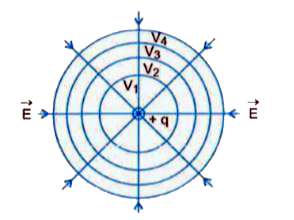 (C) Hence `q_(1)=+1 muC=+1 xx 10^(-6) C, q_(2)=-1muC=-1 xx 10^(-6) C, q_(3)=+2muC=+2 xx 10^(-6) C and r_(12)=r_(13)=r_(23)=10 CM =0.1m` Work done is assembling the charges =Potential energy of charge alignment `W=U=1/(4pi epsi_(0)) [(q_(1)q_(2))/(r_(12))+(q_(1)q_(3))/(r_(13))+(q_(2)q_(3))/(r_(23))]` 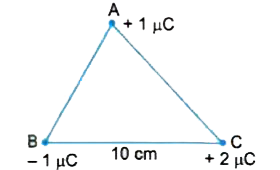 `=9 xx 10^(9) [(1 xx 10^(-6)) xx (-1 xx 10^(-6))/(0.1) +(1 xx 10^(-6)) xx (2 xx 10^(-6))/(0.1) +(-1 xx 10^(-6)) xx (2 xx 10^(-6))/(0.1)]` =0.09J |
|