

Saved Bookmarks
| 1. |
Find the potential difference V_(a)-V_(b) between the points (1) and (2) shown in each part of Fig. |
|
Answer» Solution :(a) We first distribute the charges on DIFFERENT capacitors and branches keeping in mind Kirchhoff's junction rule .We can START from any battery. In this case, We start from battery `epsilon_(1)`. Let battery `epsilon_(1)` supply a charge `q` The charge on the left plate of capacitor `C_(1)` wil be `q` as this plate is receiving the charge. Now charge `q` reches junction `b` where it is divided into two Paths. Let charge `x` go to capacitor `C_(3)`, then the remaining charge `q-x` will go to capacitor `C_(2)`. In juncation `a`, we can verify Kirchoeff's juncation rule, i.e., the incoming charge is equal to the outgoing charge. Now we write the loop equations. For loop `1` `2 - (q)/(2) - (x)/(C) = 0` For loops `2` `2 + (x)/(C) - ((q-x))/(2) = 0` (i) or `2 + (x)/(C) - (q)/(2) + (x)/(2) = 0` ......(ii) From `(i)` and `(ii)` `(2x)/(C) + (x)/(2) = 0` or `x ((2)/(C) + (1)/(2)) = 0` or `x = 0`(since `(2)/(C) + (1)/(2) ne 0`) No charge will go to the capacitor connected across `(1)-(2)`. A there is no charge in the capacitor connected across `(1)` and `(2)`, the potential difference across `(1)` and `(2)` should be zero. 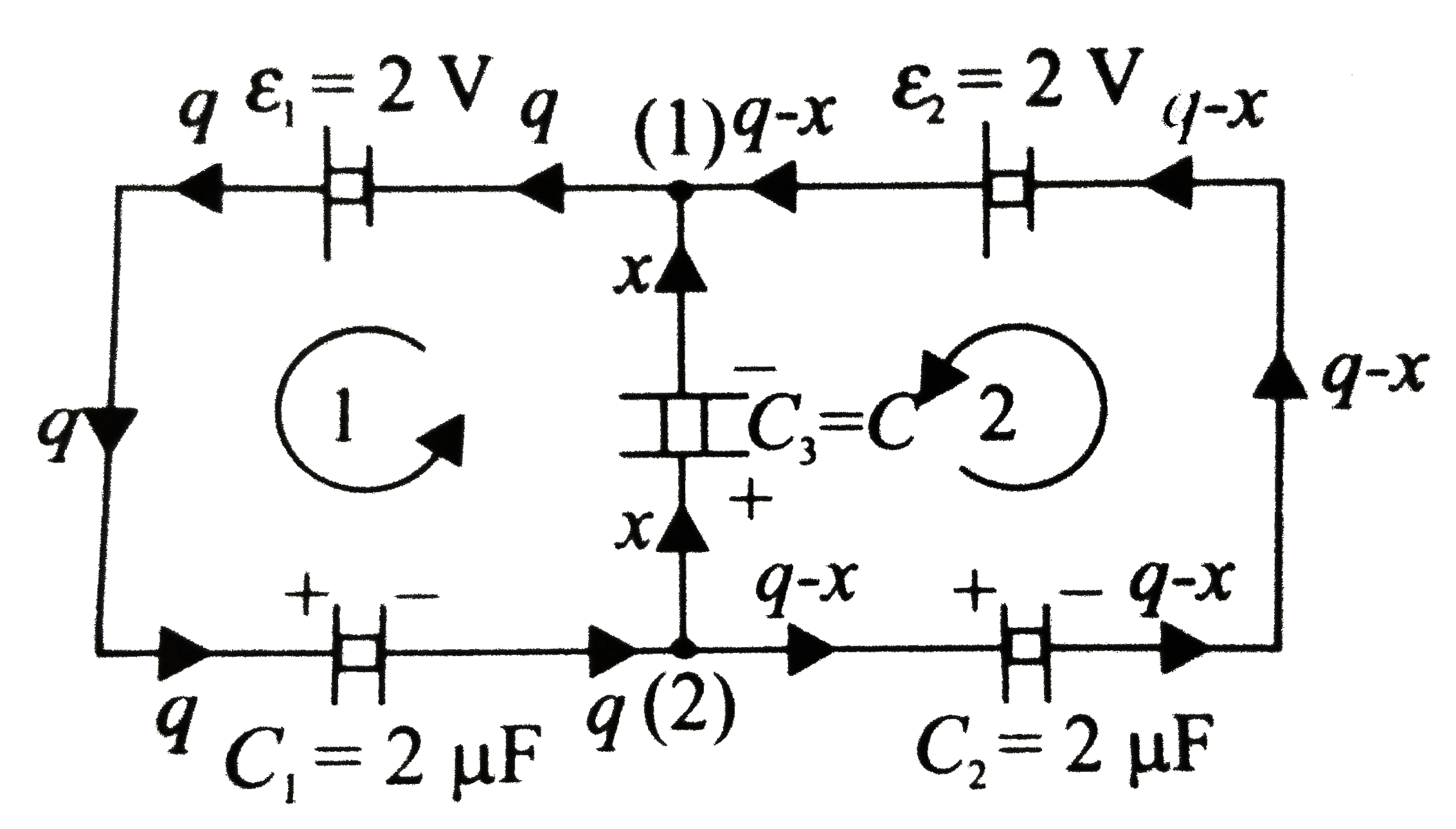 (b) In this case also, we will first distribute the charges. Let us start from the `24 V` battery. Let this battery supply a charge `q`, which is divided into two paths after reaching juncation `(2)`. Let `x` charge MOVE toward the `2 MUF` capacitor, then the reminaning charge `q - x` will move toward the `4 muF` capacitor, as per Kirchhoff's juncation rule. Now we write the loop equations. In the upper closed loop `+6+((q-x))/(4)-(x)/(2)-12=0` or `(q)/(4)-x=6`....(i) In the lower closed loop `12+(x)/(2)+(q)/(1)-24=0` or `q + (x)/(2) = 12`.....(ii) From `(i)` and `(ii)`, `x = (-8)/(3) mu C` Moving from `(1)` to `(2)` through middle path `V_(a) + 12 - (8//3)/(2) = V_(b)` or `V_(a) - V_(b) = (4)/(3) - 12 = (-32)/(3) V` |
|