

Saved Bookmarks
| 1. |
Following are equimolal (=f equimolar) aqueous solutions (A) 1 m glucose (B) 1m NaCl (C) 1m BaCl_(2) (D) 1m Na_(3)PO_(4) (E) 1m benzoic acid. assume 100% ionisation in B,C,D and 100% dimer formation in E arrange them in increasing (1) boiling point, (2) freezing point, (3) osmotic pressure, (4) vapour pressure.\ |
Answer» 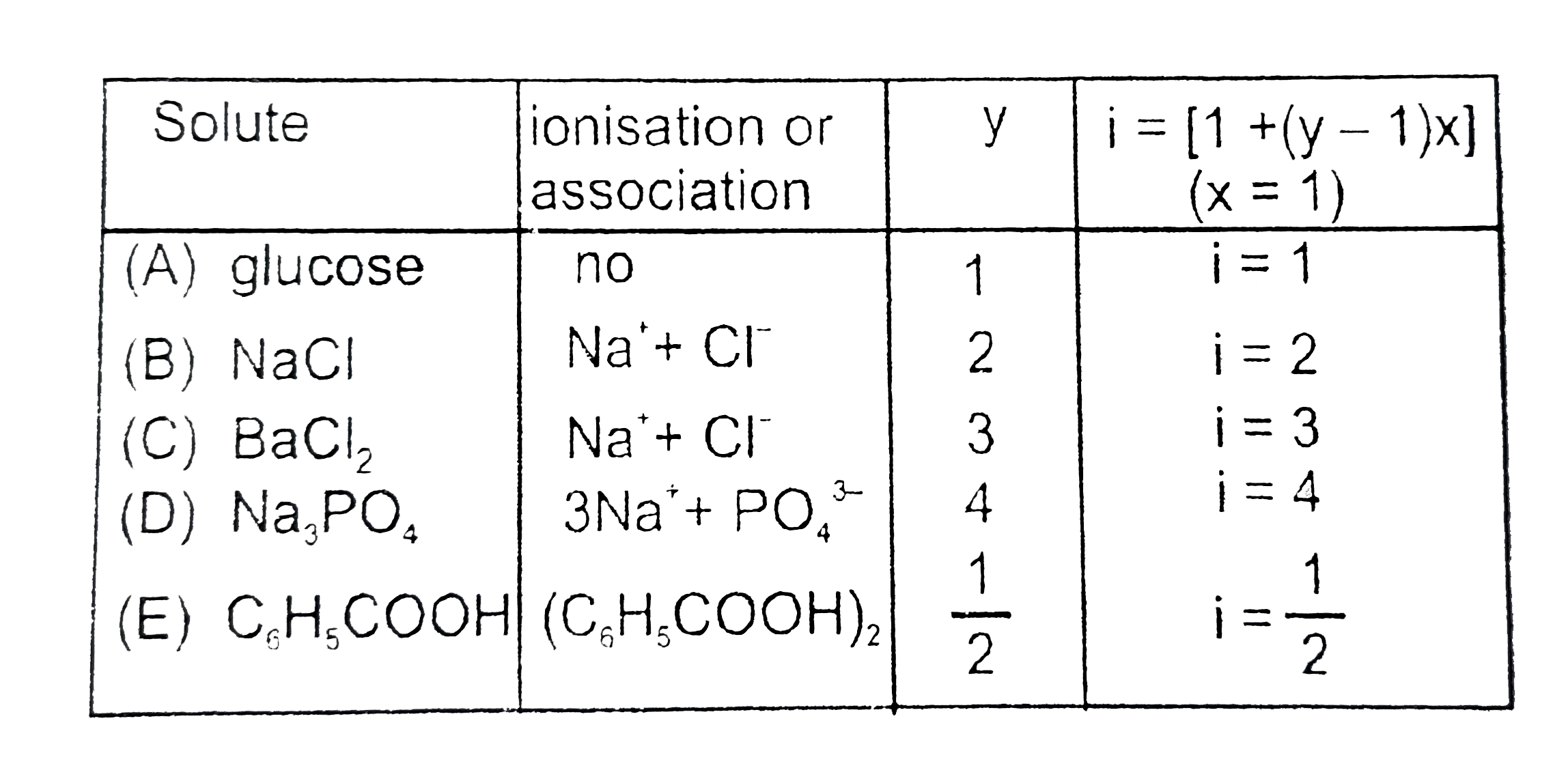 (1) Boiling point of solution `T=T_(0)+(DeltaT_(b))` `DeltaT_(b)=mK_(b)i` ltbRgt THUS, greater the value of `i`, greater the value of `DeltaT_(b)` and boiling point of solution. `therefore EltAltBltCltD` (2) Freezing pont of solution `T=T_(B)-(DeltaT_(f))` `DeltaT_(f)=mK_(f)i` Thus, greater the value of `i`, greater the value of `DeltaT_(f)` but smaller the value of freezing point. Thus, `EltAltBltCltD` (4)Vapour pressure of solution `P_("solution")=P_("solvent")^(0)-DELTAP` `(DeltaP)/(P^(0))=X_("solute")=(n_(1)i)/(n_(1)i+n_(2))=(n_(1)i)/(n_(2))` `therefore` The greater the value of `i`, greater the value of `Delpap` hence, smaller the value of vapour pressure of solution. Thus, `DltCltBltAltE`. |
|