

Saved Bookmarks
| 1. |
For circuits used for transporting electric power, a low power factor implies large power loss in transmission. Explain. |
|
Answer» Solution :(a) We know that `P = I V cosphi` where `cosphi` is the power factor. To supply a given power at a given voltage, if `cosphi`is small, we have to increase current accordingly. But this will lead to large power loss `(I^(2)R)` in transmission. (b)Suppose in a circuit, current I lags the voltage by an angle `PHI`. Then power factor `cosphi =R//Z`. We can improve the power factor (tending to 1) by making Z tend to R. LET us understand, with the help of a phasor diagram (Fig.) how this can be achieved. Let us resolve I into two components. `I_(p)` along 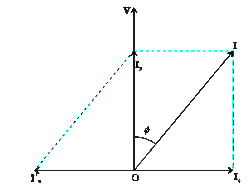 the applied voltage V and `I_(q)`perpendicular to the applied voltage. Iq as you have learnt in Section 7.7, is called the wattless component since corresponding to this component of current, there is no power loss. `I_(p)` is known as the power component because it is in phase with the voltage and corresponds to power loss in the circuit. It’s clear from this analysis that if we want to improve power factor, we MUST completely neutralize the lagging wattless current `I_(q)` by an equal leading wattless current `I._(q)`. This can be done by connecting a capacitor of APPROPRIATE value in parallel so that `I_(q)` and `I._(q)`cancel each other and P is effectively `I_(p) V`. |
|