

Saved Bookmarks
| 1. |
For the transistor circuit shown in Fig., evaluate V_(E), R_, R_(E) given I_(C)=1mA, V_(CE)=3V, V_(BE)=0.5V and V_(C C)=12V, beta=100. |
Answer» Solution :Let the current through the various ARMS be as SHOWN in Fig.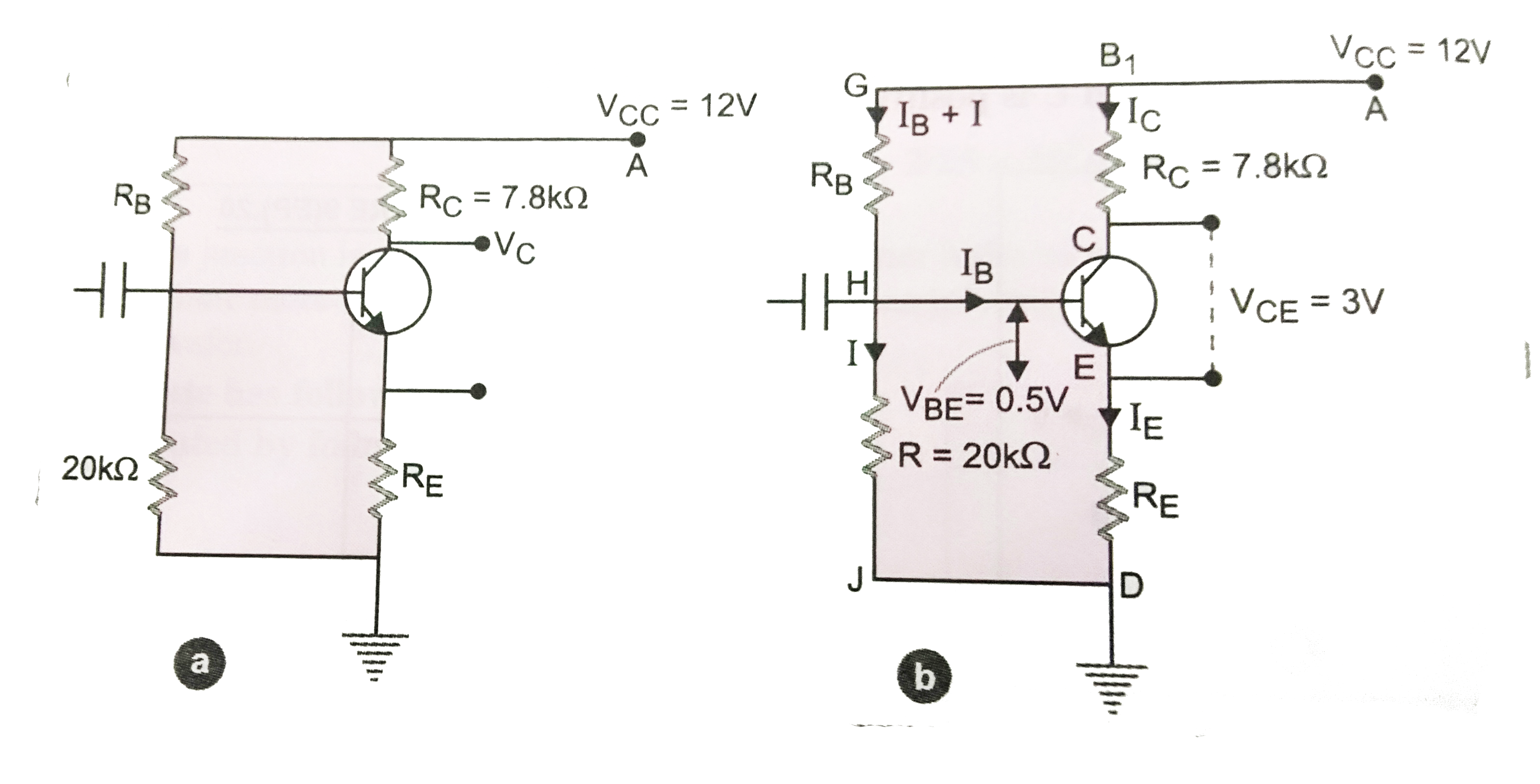 Here, `I_C=1mA=10^(-3)A, V_(CE)=3V, V_(BE)=0.5V, beta=100` `I_B=I_C/beta=10^(-3)/100=10^(-5)A=.01mA` `I_(E)=I_B+I_C=10^(-5)+10^(-3)~~10^(-3)A=I_C` In closed circuit, `AB_(1)CEDA` I_C R_C+V_(CE)+I_(E)R_(E)=V_(C C)` or`I_C R_C+I_C R_(E)=V_(C C)-V_(CE)=12-3=9V[ :' I_(E)=I_C]` or`I_C(R_C+R_(E))=9orR_C+R_(E)=9/10^(-3)=9kOmega` `R_(E)=9kOmega-R_=9kOmega-7.8kOmega=1.2kOmega=1.2xx10^(3)Omega` `V_(E)=I_(E)R_(E)=I_C R_(E)=10^(-3)xx(1.2xx10^(3))=1.2V` Let V= potential difference between H and J, then `V=V_(E)+V_(BE)=1.2+0.5=1.7V` `I=V/R=1.7/(20xx10^(3))A=0.085mA` Now `V_(C C)=(I_B+I)R_B+V` or`R_B=(V_(C C)-V)/(I_B+I)=((12-1.7)V)/((.01+0.085)mA)=(10.3V)/(0.095mA)=108.4kOmega` |
|