

Saved Bookmarks
| 1. |
Formation of image by a combination of converging and a diverging lens Find the location of the final image after all the refrections in Fig. 34-41. The radius of both the plano-convex lens and plano-concave lens is 10cm and refrective index is 1.5. |
|
Answer» Solution :Here again we are seeing an example of MULTIPLE events. The image of plano-convex lens will act as an object for the plano-concave lens. But to get there, we need to find the focal length of the lens first. CALCULATION : Focal length of the plano-convex lens is `(1)/(f)=(1.5-1)((1)/(+10)-(1)/(oo))=(1)/(20)` Focal length of plano-concave lens is `(1)/(f)=(1.5-1)((1)/(oo)-(1)/(+10))=-(1)/(20)` Since parallel beam is incident on the lens, its image from plano-convex lens will be formed at `+20cm` from it (at the focus) and will act as an object for the plano-concaveSince the two lenses are at a distance of 10cm from each other therefore for the NEXT lens `u=+10cm`. Hence `V=(uf)/(u+f)=(10xx-20)/(10-20)=20cm` Learn : We can see that a diverging lens is forming a REAL image. This is because the object for it is virtual and is between pole and object focus. 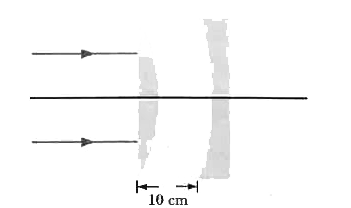
|
|