

Saved Bookmarks
| 1. |
Four identical monochromatic sources A,B,C,D as shown in the (figure) produce waves of the same wavelength lambda and are coherent. Two receiver R_(1) and R_(2) are at great but equal distances from B. (i) Which of the two receivers picks up the larger signal when B is turned off? (iii) Which of the two receivers picks up the larger singnal when D is turned off ? (iv) Which of the two receivers can distinguish which of the sources B or D has been turned off ? |
|
Answer» `R_(1)` THUS, the wave at `R_(1)` because of B is `y_(B)=a" cos"(wt-pi)= -a" cos"wt.` The path difference fo the signal from C with that from A is `lambda` adn hence, the phase difference is `2 pi`. Thus, the wave at `R_(1)` because of C is `y_(c)=a" cos"wt.` The path difference between the signals from D with that of A is `P=R_(1)D-R_(1)A=sqrt((R_(1)B)^(2)+(BD)^(2))-(R_(1)B-AB)` 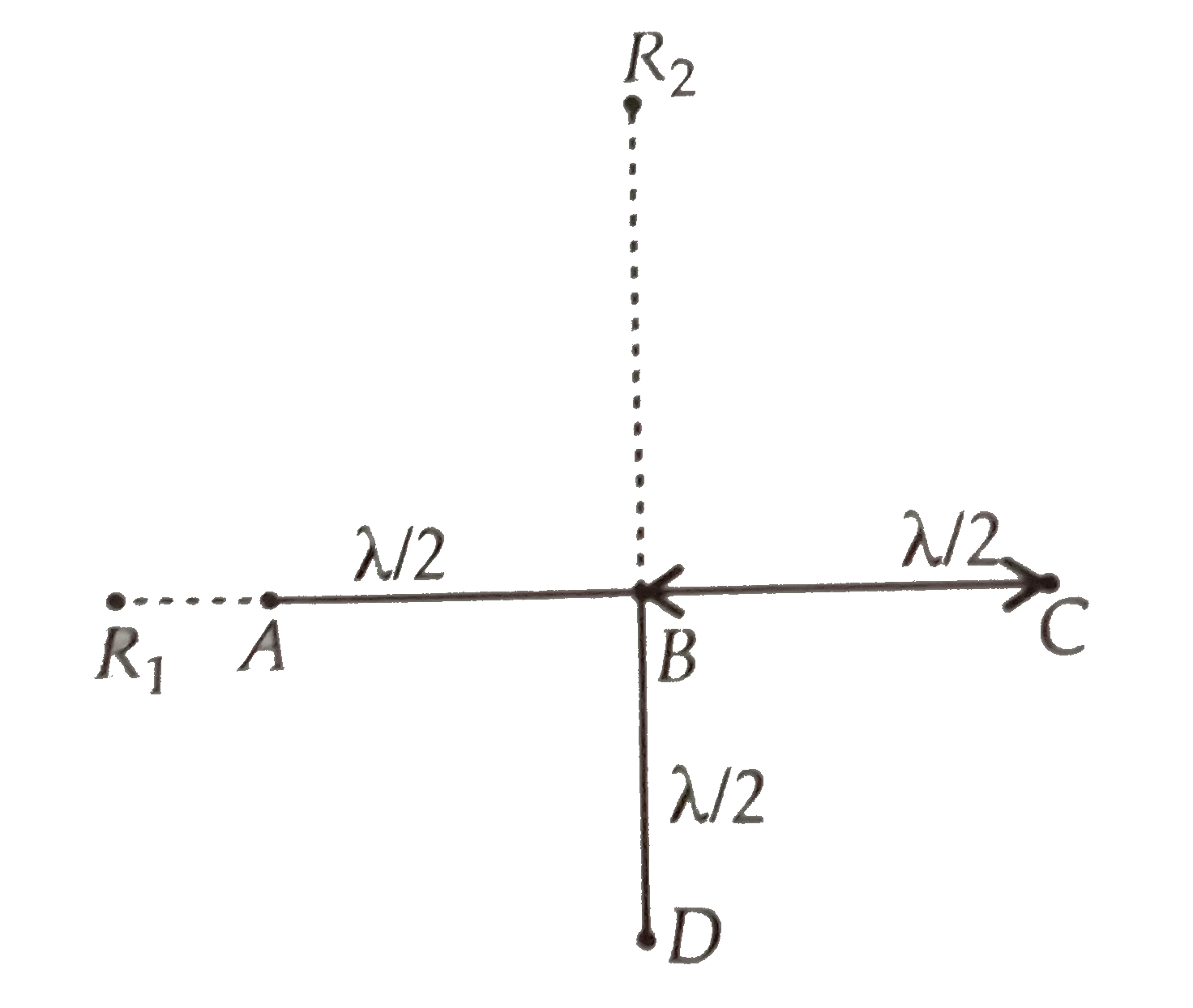 `=sqrt(d^(2)+((lambda)/(2))^(2))-(d-lambda//2)=d(1+(lambda^(2))/(4d^(2)))^(1//2)-d+(lambda)/(2)` `=d(1+(lambda^(2))/(8d^(2)))-d+(lambda)/(2)=(lambda^(2))/(8d)+(lambda)/(2)` If `d gt gt lambda,` the path difference `~(lambda)/(2)` and hence the phase difference is `pi`. ` :. y_(D)= -a" cos"wt.` Thus, the signal picked up at `R_(1)` is ` "y"="y"_(A)+"y"_(B)+"y"_(C)+"y"_(D)=0` Let the signal picked up at `R_(2)` from B be ` "y"_(B)^(')=a_(1)" cos"wt.` The path difference between signal at D and that at B is `lambda//2.` ` :. "y"_(D)^(')= -a_(1)" cos"wt` The path difference between signal at A and B is `sqrt((d)^(2)+((lambda)/(2))^(2))-d=d(1+(lambda^(2))/(4d^(2)))^(1//2)-d=(lambda^(2))/(8d)` ` :. ` The phase difference is `(2pi)/(lambda)*(lambda^(2))/(8d)=(pi lambda)/(4d)=phi~0.` Hence, ` "y"_(A)^(')=a_(1)" cos"(wt-phi)` Similarly, ` "y"_(C)^(')=a_(1)" cos"(wt-phi)` ` :.`Signal picked up by `R_(2)` is ` "y"_(A)^(')+"y"_(B)^(')+"y"_(C)^(')+"y"_(D)^(')="y"^(')=2a" cos"(wt-phi)` ` "" [ :' "y"_(B)^(')+"y"_(D)^(')=0]` ` |"y"|^(2)=4a_(1)^(2)" cos"^(2)(wt-phi)` ` :. lt I gt =2a_(1)^(2)` Thus `R_(2)` picks up the LARGE signal. |
|