

Saved Bookmarks
| 1. |
Give plausible explanation for each of the following: (i) Cyclohexanone forms cyanohydrin in good yield but 2,2,6-trimethylcyclohexanone does not. (ii) there are two -NH_(2) groups in semicarbazide. However, only one is involved in the formation of semicarbazone. (iii) during the preparation of esterns from a carboxylic acid and an alcohol in the presence of an acid catalyst, the water or the ester formed should be removed as soon it is formed. |
Answer» Solution :(i). 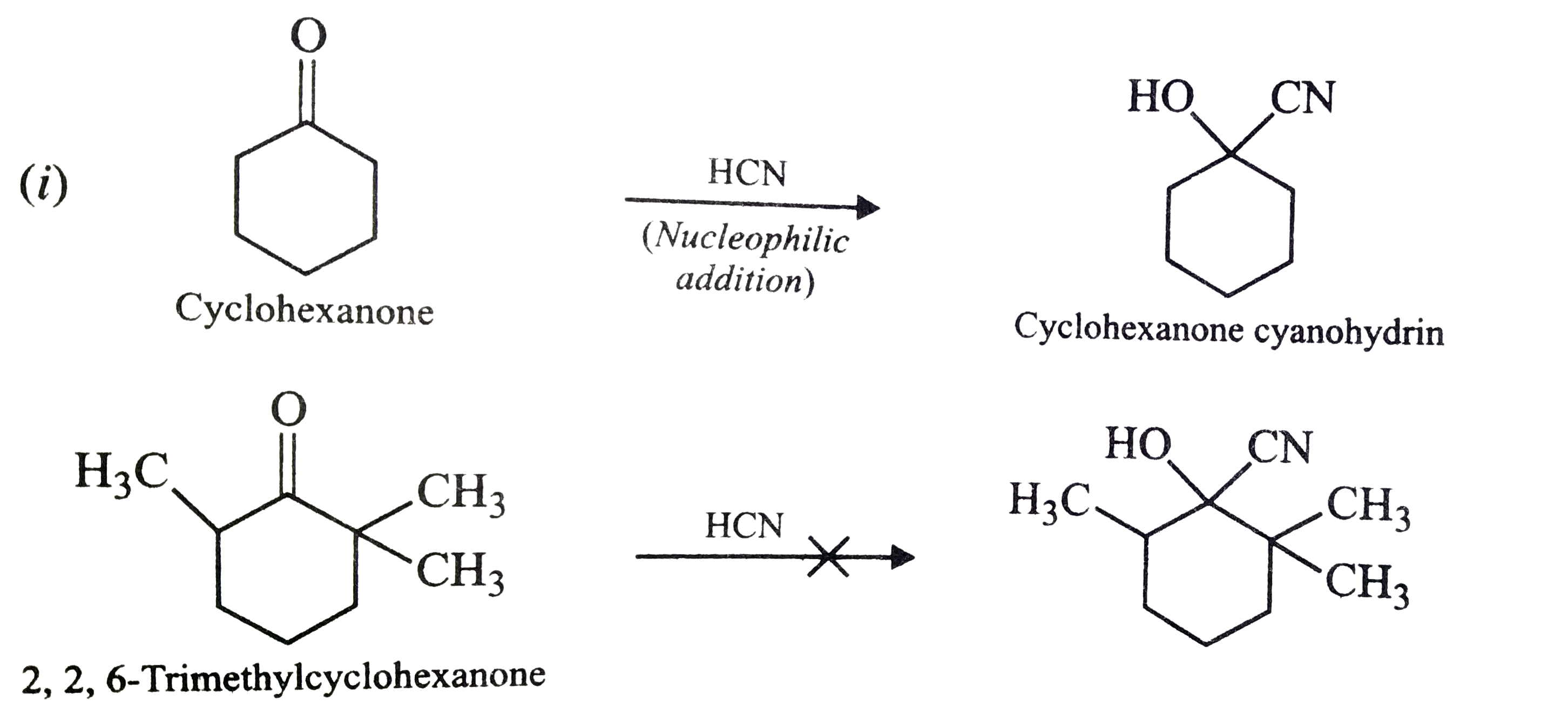 Because of the presence of three methyl groups at `alpha`-positions w.r.t. the C=O groups, the nucleophilic attack by `CN^(-)` ion does not occur due to steric HINDRANCE. Since there is no such steric hindrance in cyclohexanone, therefore, nucleophilic attach by the `CN^(-)` ion occurs readily and hence cyclohexanone CYANOHYDRIN is obtained in good yield. (ii).  Although semicarbazide has two `-NH_(2)` groups but one of them (ie.., which is directly attached to C=O) is involved in resonance as shown above. as a result, electron density on this `NH_(2)` group decreases and hence it does ot act as a nucleophile. in contrast, the lone pair of electrons on the other `NH_(2)` group (i.e., attached to NH) is not involved in resonance and hence is AVAILABLE for nucleophilic attack on the C=O group of aldehydes and ketones. (iii) The FORMATION of esters from a carboxylic acid and an alcohol in presence of an acid catalyst is a reversible reaction. `underset("Carboxylic acid")(RCOOH)+underset("Alcohol")(R'OH) overset(H_(2)SO_(4))hArr underset("Ester")(RCOOR')+H_(2)O` To shift the equilibrium in the forward direction, the water or the ester formed should be removed as fast as it is formed. |
|