

Saved Bookmarks
| 1. |
Give reasons for the following: (i) Oximes are more acidic than hydroxylamine. (ii) Iodoform is obained by the reaction of acetone with hydroiodite but not with iodide ion. (iii) Oxidation of toluene to benzaldehye with CrO_(3) is carried out in presence of acetic anhydride and not in presence of H_(2)SO_(4). |
Answer» Solution :(i) Loss of a proton from an oxime gives a conjugate ase which is stabilized by resonacne but the conjugate base of `NH_(2)OH` is not. 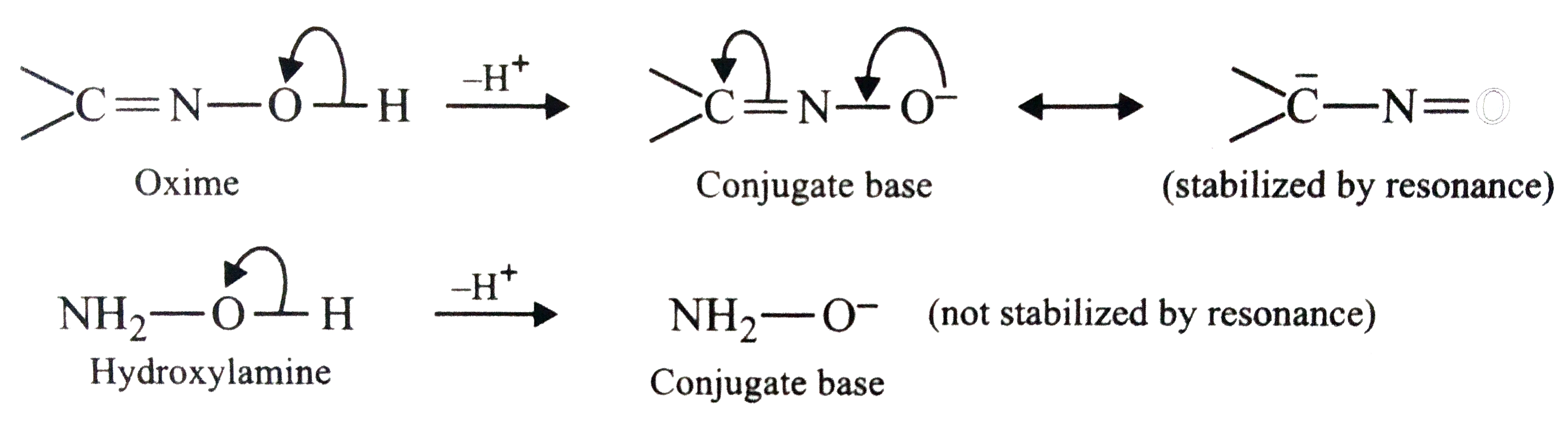 (ii) To prepare iodoform from acetone, `I^(+)` is required which is supplied by `IO^(-)` ion but not by `I^(-)` ion as shown below:  `CH_(3)COCH_(2)I^(-) underset(-OH^(-))overset(+IO^(-))to CH_(3)COCHI_(2) underset(-OH^(-))overset(+IO^(-))to underset(alpha,alpha,alpha-"Tripiodoacetone")(CH_(3)COCI_(3)) overset(OH^(-))to underset("Iodoform")(CHI_(3))+ underset("ACETATE ion")(CH_(3)COO^(-))` (iii) During oxidation of toluene with `CrO_(3)//H_(2)SO_(4)`, the intermediate benzaldehyde formed readily undergoes oxidation to form benzoic acid due to the presence of `H_(2)O` in `H_(2)SO_(4)`. `underset("Toluene")(C_(6)H_(5)-CH_(3)) underset(Delta)overset(CrO_(3)//H_(2)SO_(4))to underset("Benzaldehyde")(C_(6)H_(5)-CHO) overset(H_(2)O)to underset("Benzaldehyde hydrate")(C_(6)H_(5)CH(OH)_(2)) overset(CrO_(3)//H_(2)SO_(4))to underset("Benzoic acid")(C_(6)H_(5)COOH)` However, with `CrO_(3)` in `(CH_(3)CO)_(2),O`, due to the absence of `H_(2)O` as SOON as benzaldehyde is formed, it reacs with acetic anhydride to form benzylidene diacetate which does not undergo further oxidation. in this way, oxidation of benzaldehyde to benzoic acid is prevented.t he gen-diacetate thus formed upon subsequent hydrolysis with alkali or acid gives benzaldehyde. `underset("Toluene")(C_(6)H_(5)CH_(3)) underset(273K-283K)overset(CrO_(3)//(CH_(3)CO)_(2)O)to underset("Benzylidene diacetate (gem-diacetate)")(C_(6)H_(5)CH(OCOCH_(3))_(2)) underset(("Hydrolysis"))overset(H_(3)O^(+),Delta)to underset("Benzaldehyde")(C_(6)H_(5)CHO)+ underset("Acetic acid ")(2CH_(2)COOH)` |
|