

Saved Bookmarks
| 1. |
Give reasons for the following : (i) Phenol is more acidic than methanol. (ii) The C-O-H bond angle in alcohols is slightly less than the tetrahedral angle (109^(@)28'). (iii) (CH_(3))_(3) C-O-CH_(3)" on reaction with HI gives "(CH_(3))_(3)C-I and CH_(3)-OH" as the main products and not "(CH_(3))_(3) C-OH and CH_(3)-I. |
Answer» Solution :(i) When phenol lose the penolate ion is stabilized due to the resonance effect. The energy of the DISSOCIATED form is lower and so the phenol has more chance to be in the solution dissociated with the phenolate ion. Aliphatic alcohol are not stabilized by resonance so they are not very prone to be dissociated.  (ii) The C-O-H bond angle in alcohol is slightly less than the tetrahedral angle `(109^(@)28).` It is due to the repulsion between the unshared electron pairs of oxygen. 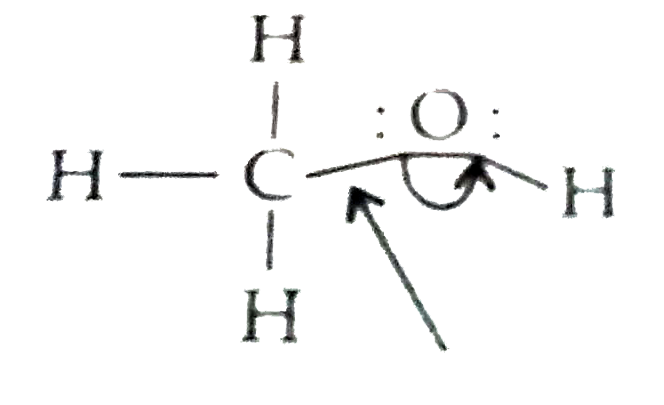 S slightly greater than the tetrahedral angle `(109^(@)28)` due to the repulsive C-O bond length (141 pm) in ethers is ALMOST the same as in alcohols (142 pm) in methanol. (iii) USUALLY, iodide being a BIG nucleophile, attacks on the group with low steric hindrance and the reaction proceeds by `S_(N)2` mechanism. However, in this case, methanol, on leaving generates a tertiary carbocation, which is more stable. Hence, this reaction proceeds by `S_(N)1` mechanism and therefore, we get `(CH_(3))_(3) C-I and CH_(3)-CH` as the MAJOR products. 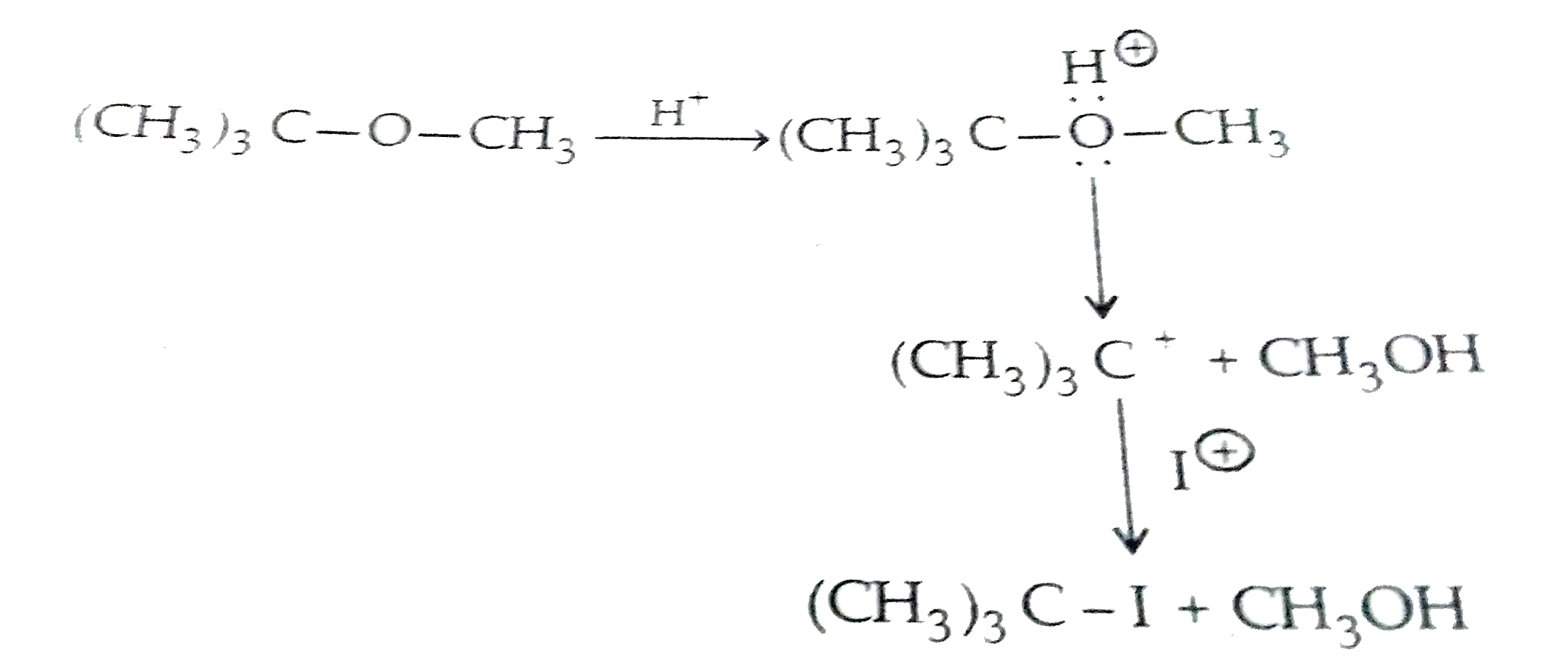
|
|