

Saved Bookmarks
| 1. |
Give the Molecular Orbital Energy diagram of (a) N_(2) and (b) O_(2). Calculate the respective bond order. Write the magnetic nature of N_(2) and O_(2) molecules. |
Answer» Solution :a) MOLECULAR Orbital Energy diagram of `N_(2)` :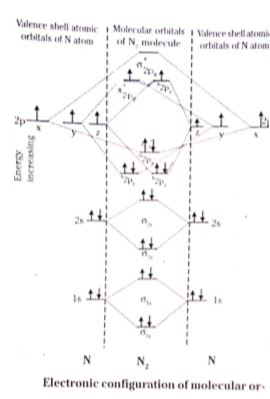 Electronic configuration of molecular orbital of `N_(2)` : `sigma1s^(2),sigma^(star)1s^(2), sigma2s^(2), sigma^(star)2s^(2), pi2p_(y)^(2)=pi2p_(z)^(2), sigma2p_(x)^(2)` Calculation of bond order of `N_(2)` : Number of bondingelectrons `(N_(b))` = 10 Number of anti-bonding electrons `(N_(a))` = 4 Bond order `=1/2(N_(b)-N_(a))` `=1/2(10-4)=3` Nitrogen is DIAMAGNETIC since all the electrons in `N_(2)` molecule are paired. b) Molecular Orbital Energy diagram of `O_(2)` : 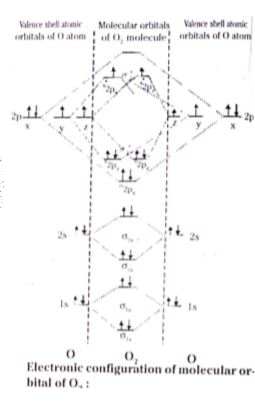 Electronic configuration of molecular orbital of `O_(2)` : `sigma1s^(2), sigma^(star)1s^(2), sigma2s^(2), sigma^(star)2s^(2), sigma2p_(x)^(2), pi2p_(y)^(2)=pi2p_(x)^(2), pi^(star)2p_(y)^(1)=pi^(star)2p_(z)^(1)` Calculation of bond order of `O_(2) :` Number of bonding electrons `(N_(b))=10` Number of anti-bonding electrons `(N_(a))=6` Bond order `=1/2(N_(b)-N_(a))=1/2(10-6)=2` Oxygen is paramagnetic as there are two UNPAIRED electrons in two antibonding `pi^(ast)2p_(y) " and " pi^(ast)2p_(z)` molecular orbitals. So oxygen is diamagnetic. |
|