

Saved Bookmarks
| 1. |
Here is an example of where you must dig information out of a graph, not just read off a number. In Fig. 5-24a, two forces are applied to a 4.00 kg block on a frictionless floor, but only force vec(F)_(1) is indicated. That force has a fixed magnitude but can be applied at an adjustable angle theta to the positive direction of the x axis. Force F_(2) is horizontal and fixed in both magnitude and angle. Figure 5-24b gives the horizontal acceleration a_(x) of the block for any given value of theta from 0^(@) to 90^(@). What is the value of a_(x) for theta=180^(@) ? |
|
Answer» Solution :(1) The horizontal acceleration `a_(x)` depends on the net horizontal force `F_("net, x")`, as given by Newton.s second law. (2) The net horizontal force is the sum of the horizontal COMPONENTS of forces `vec(F)_(1)` and `vec(F)_(2)`. Calculations: The x COMPONENT of `vec(F)_(2)` is `F_(2)` because the vector is horizontal. The x component of `vec(F)_(1)` is `F_(1)cos theta`. USING these EXPRESSIONS and a mass m of 4.00 kg, we can write Newton.s second law `(vec(F)_("net")=m vec(a))` for motion along the x axis as `F_(1)cos theta+F_(2)=4.00a_(x),""(5-35)` From this equation we see thyat when angle `theta=90^(@),F_(1)cos theta` is zero and `F_(2)=4.00a_(x)`. From the graph we see that the corresponding acceleration is `0.50" m"//"s"^(2)`. Thus, `F_(2)=2.00` N and `vec(F)_(2)` must be in the positive direction of the x axis. From Eq. 5-35, we find that when `theta=0^(@)`, `F_(1)cos 0^(@)+2.00=4.00a_(x).""(5-36)` From the graph we see that the corresponding acceleration is `3.0" m"//"s"^(2)`. From Eq. 5-36, we then find that `F_(1)=10` N. 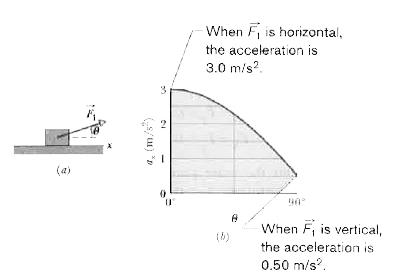 FIGURE 5-24 (a) One of the two forces applied to a block is shown. Its angle `theta` can be varied. (b)The block.s acceleration component `a_(x)` versus `theta`. Substituting `F_(1)=10" N",F_(2)=2.00" N"," and "theta=180^(@)` into Eq. 5-35 leads to `a_(x)=-2.00" m"//"s"^(2)` |
|