

Saved Bookmarks
| 1. |
How are alpha-halo carboxylic acids obtained from carboxyliv acids? OR Explain Hell-Vohlard-Zelinsky(HVZ) reaction. |
|
Answer» Solution :carboxylicacid reacts with chlorine or bromine, in the presence of small amount of red phosphorus to form`alpha`-halocarboxylic acid. The reaction is calledHell-Vohlard-Zelinsky reaction. The importance of the reaction is that only `alpha`-HYDROGEN is substituted. `R-overset(alpha)underset(underset(H)(|))(C)H -COOH overset(1.X_(2)//"red P")underset(2.H_(2)O)(rarr)R-underset(underset(X)(|))(C)H - COOH + HX` When phenyl acetic acid is treated with bromine and red Phosphorus, 2- Brom -2 - phenyl acetic acid is obtained. 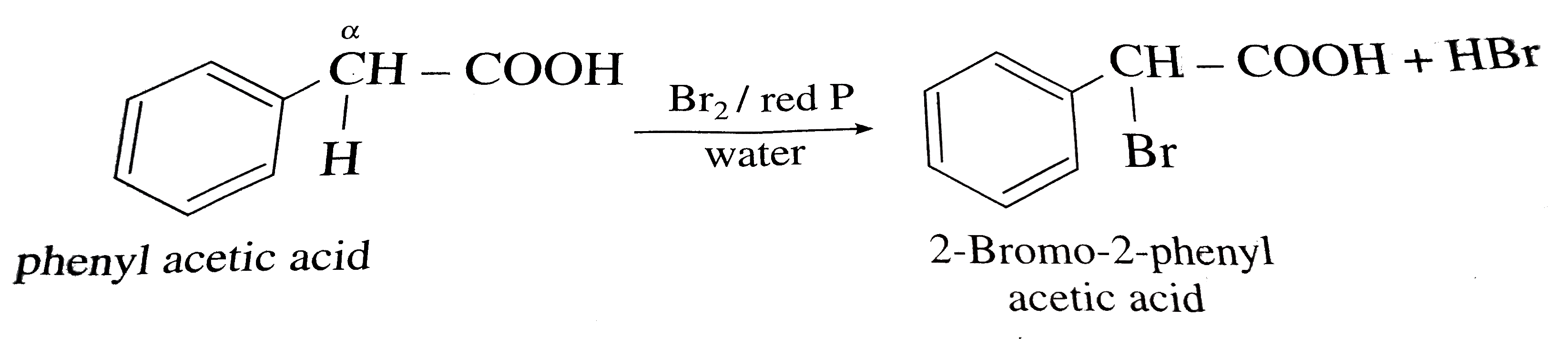 When acetic is treated with EXCESS of bromine and red phosphorus, TRIBROMO acetic acid is obtained. `CH_(3)-COOHoverset(Br_(2)//"red P")underset(-HBr)(rarr)BrCH_(2)-COOH overset(Br_(2)//"red P")underset(-HBr)(rarr) Br_(2) CH-COOH` `overset(Br_(2)//"red P")underset(-HBr)(rarr) Br_(3) C-COOH` tribromo acetic acid When propionic acid is treated with excess of bromine and red phosphorus 2,2- dibromo propionic acid is obtained. `underset(underset("Propionic acid")())(CH_(3)-)CH_(2)-COOHoverset(Br_(2)//"red P")underset(-HBr)(rarr)CH_(3)_ underset(underset(Br)(|))(C)H-COOH` ` overset(Br_(2)//"red P")underset(-HBr)(rarr)CH_(3)-overset(overset(Br)(|))underset(underset(Br)(|))(C)-COOH` 2,2 dibromopropionic acid |
|