

Saved Bookmarks
| 1. |
How are carbon and hydrogen of an organic compound estimated? |
Answer» Solution :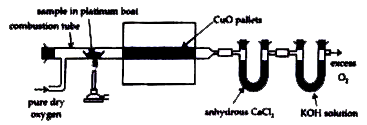 A known weight of the organic compound is taken and completely burnt in excess of air and copper (II) oxide. Then carbon oxidises to `CO_(2)` and hydrogen oxidises to `H_(2)O`. The `CO_(2)` and `H_(2)O` so obtained are passed through already weighed U TUBES containing anhydrous `CaCl_(2)` and caustic potash RESPECTIVELY. The increased weights of these TWO tubes give the weights of `H_(2)O` and `CO_(2)` formed. Suppose that 'a'g of organic compound on combustion gives 'b' g of water vapour and 'c'g of `CO_(2)`. % of carbon: 44 g of `CO_(2)` contains 12 g of carbon. `therefore` 'c'g of `CO_(2)` contains . ..? `=(12xxc)/44` g of carbon 'a' g of organic compound contains `(12xxc)/44` g of carbon `therefore` 100 organic compound contains ………………. ? `= (100 xx 12 xx c)/(a xx 44)` g of carbon (% of C) % of hydrogen : 18 g of water contains 2 g of `H_(2)` `therefore ` b of water contains …………… ? `= (b xx 2)/(18)` g of hydrogen a g of organic compounds contains `(b xx 2)/(18)` g of hydrogen . `therefore` 100 g of organic compound contains ........... ? `= (b xx 2 xx 100)/(18 xx a)` g of hydrogen (% of H) |
|