

Saved Bookmarks
| 1. |
How do you account for the reducing behaviour of H_(3)PO_(2)?Why are pentahalides more covalent than Trihalides? (iii) Bond angle in PH, is higher than that in PH_(3) Why? (iv) What is the basicity of H_(3)PO_(4)? |
|
Answer» Solution :(i)The structure of `H_(3)PO_(2)` has two P-H bonds. Due to the presence of these P-H bonds, H3PO, acts as a strong reducing agent. For example, it reduces A educes `AgNO_(3)` to metallic Ag and arenediazonium salts to arenes. `4AgNO_(3)+H_(3)PO_(2)+2H_(2)Oto4Ag+H_(3)PO_(4)+4HNO_(3)` (ii)The elements of group 15 have five electrons (two in the s- and three in the p-orbitals) in their respective Valence shells. Since it is difficult to lose all the three electrons to form Eo or even more difficult to lose all the five valence electrons two S- and three p.) to E ions, therefore, HIGHER elements have no tendency to form ionic compounds. Instead they form covalent compounds by sharing of electrons. Since elements in the +5 oxidation state have less tendency to lose electrons than in the +3 oxidation state, therefore elements in the +5 oxidation have more tendency to share electrons than in the +3 oxidation state. Thus, elements in the +5 oxidation state are more covalent than in the +3 oxidation state. In other words, pentahalides are more covalent than trihalides. (iii)P in `PH_(3)` is sp -hybridized. It has three bond pairs and one lone pair around P. Due to stronger lone pair - bond pair repulsions than bond pair repulsions, the tetrahedral angle decreases from `109^(@)` - 28" to 93.6". As a result, `PH_(3)` is Pyramidal. However, when it reacts with a PROTON, it forms PH, ion which has four bond pairs and no lone pair. Due to the absence of lone pair - bond pair repulsions and presence of four identical bond pair - bond pair interactions, PH assumes tetrahedral geo-metry with a bond angle of `109^(@) -28`.. This EXPLAINS why the bond angle inhigher than in `PH_(3)` 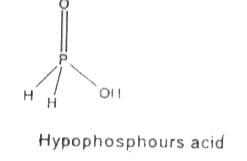 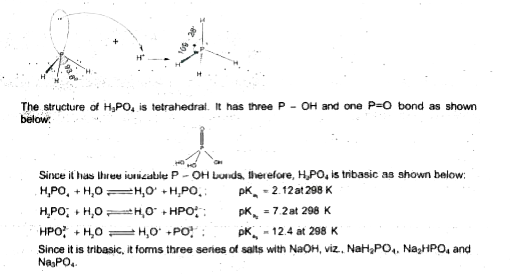
|
|