

Saved Bookmarks
| 1. |
How does a transition metal ion acquire a colour? |
|
Answer» SOLUTION :(1) The transitionmetal ions hashaveincompelety filled(n-1) d-orbitlas. (2)d-orbitalsare degenerteorbitals, i.e., all fivesuborbitals of d-orbitalsnamely `d_(xy) , d_(yz), d_(x^(2) - y^(2)), d_(z^(2))` havenearly equal energy in a free METAL ions. (3) Incompounds , in the pressnceof anionsor complexingligands,degenergyis lostand these fivedegenerate d-orbitalssplits into twogroupsas follows. (i)ONEGROUP of d-orbitalshave lowerenergyand consistsof three orbitals NAMELY `d_(xy)d_(xy)` and `d_(xy)` .THEYARE called`t_(2g)`orbitals . (ii) The secondgroupof d-orbitalshavehigherenergyand consisttwo orbitals `d_(x^(2) - y^(2))`and `d_(z^(2))`and they are called `e_(g)` orbitals. 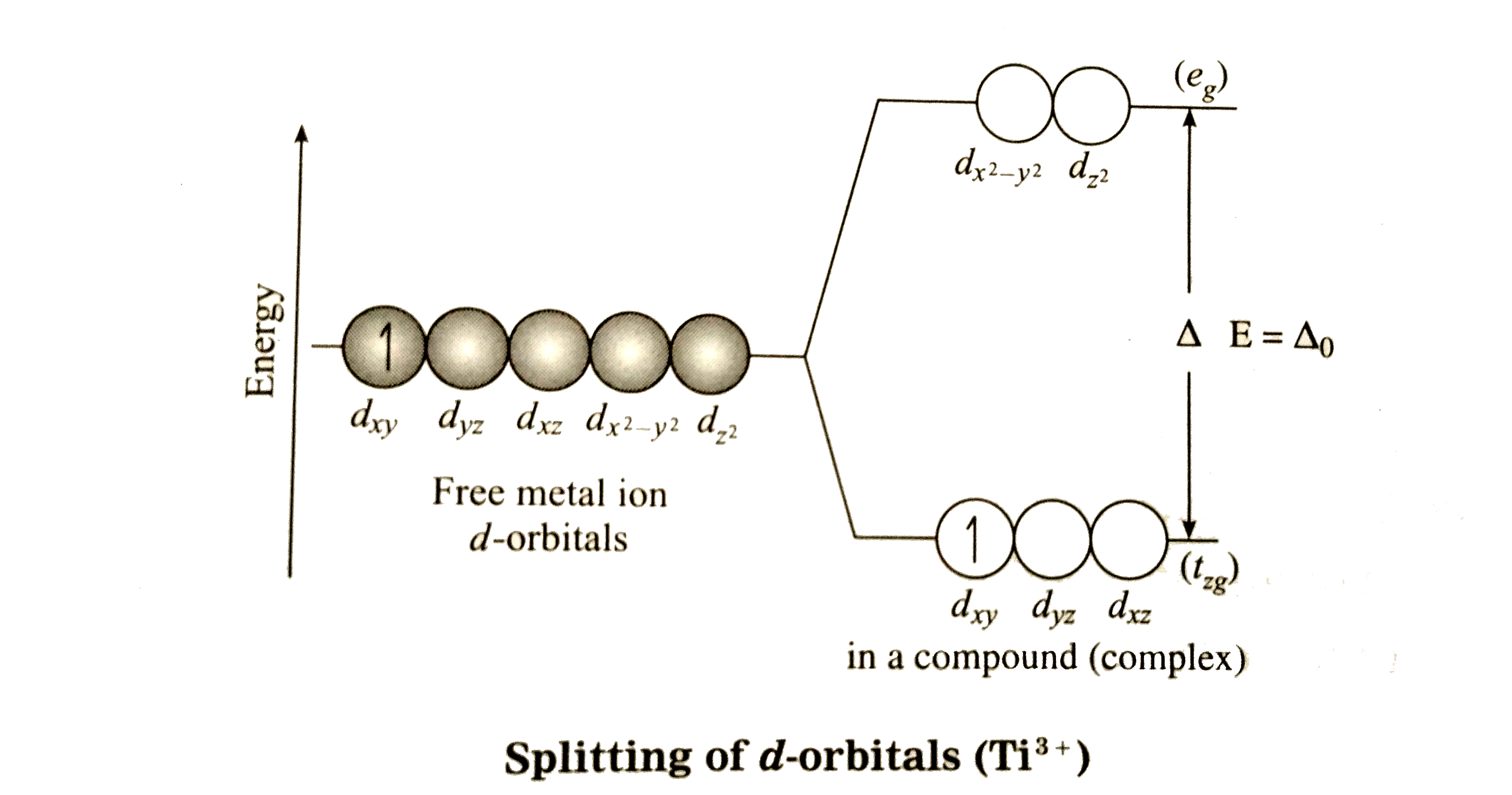 (4) They energydifferenec `DeltaE` betweenthesetwosets of d-orbitalsis calledcrystal be field splittingenergy (CFSE). (5) `DeltaE`has verysmallvalueequal tothe energyof electromagneticradiationin the visibleregion `(DeltaEhu = (hc)/(lambda))` (6) There ariesea transitionof oneor moreunpaired electronsform `t_(2g)` orbitalsto `e_(g)` orbitalsdueto theabsorptionof radiation in thevisible region. (7) When theelectron d-orbitals`(t_(2g))`it transmits thelightthatiscomplementaryin colour to colourof radiationabsorbed. Thisimpartsa characteristiccolourto thecompoundor a metal ion. Forexamplein the figurethetransitionof one elecrons`(3d^(1))`in thecomplex `[Ti(H_(2)O)_(6)]^(3+)`is shown. |
|