

Saved Bookmarks
| 1. |
How does the polarised cliclectric morufy the original external field inside it ? |
|
Answer» Solution :When POLAR or non-polar molecules placed in an external electric field a dielectric develops a net dipole moment. The dipole moment per unit volume is called polarisation and is denoted by `vecP` . For linear isotropic dielectrics , `vecPprop VECE` `:. vecP = chi_(e)` is a constant CHARACTERISTIC of the dielectric and is known as the electric susceptibility of the dielectric medium. 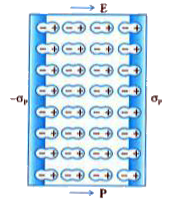 Consider a rectangular dielectric slab placed in a uniform external field `vecE_(0)` parallel to two of its faces as shown in figure. Titis field causes a uniform polarlzation`vecP` of the dielectric . Every volume element `DeltaV` of the slab has a dipole moment `vecP Delta` V in the direction of the field . The volume element AV is macroscopically small but contains a very large number of molecular dipoles. It has no net charge (Total charge on dipole is zero) but has net dipole moment. Because, the posldve charge of one dipole sits close to the negative charge of the adjacent dipole in rectangular slab. HOWEVER at the surfaces of the dielectric normal to the electric field there is a net charge DENSITY. In figure, the unbalanced charges are the induced charges due to the external field. Thus the polarized dielectric is equivalent to two charged surfaces with induced surface charge densities `sigma` and `sigma_(p)` . The field produced by these surface charges opposes the external field hence the total electric field `E_(0)` in the dielectric is reduced. The surface charge density `pm sigma_(p)` arises from bound charges but not by free charges in the dielectric. |
|