

Saved Bookmarks
| 1. |
How is a wavefront defined? Using Huygen'sconstruction , draw a figure showing the propagation of a plane wave refractingat a plane surface separatingtwo media. Hence verify Snell's law of refraction. |
|
Answer» Solution :(i) Wavefront : The continuous locus of all the particles of amedium, which are vibrating in the same phase is called a wavefront. (ii) Snell's law of refraction : Let PP' represent the surface SEPARATING medium 1 and medium 2 as shown in FIG. Let `v_(1) and v_(2)` represent the speed of light in medium 1 and medium 2 respectively. We assume a plane wavefront AB propagating in the direction A' A incident on the interface at an angle i. Let i be the taken by the wavefront to travel the distance BC. `:. BC=v_(1)t` [distance = speed `xx`time] In order to determine the shape of the refracted wavefront, we draw a sphere of radius `v_(2) t` from the point A in the second medium (the speed of the wave in second medium is `v_(2)`). Let CE represent a tangent plane drawn from the point C. Then `AE=v_(2)t`. `:.` CE would represent the refracted wavefront. In `DeltaABC and DeltaAEC`, we have `sin i = (BC)/(AC)=(v_(1)t)/(AC) and sin r=(AE)/(AC)=(v_(2)t)/(AC)` where i and r are the ANGLES of incidentand refraction respectively. `:. (sin i)/(sin r)=(v_(1)t)/(AC). (AC)/(v_(2)t) rArr (sin i)/(sinr)=(v_(1))/(v_(2))` If C represents the speed of light in vacuum, then `n_(1)=(C)/(v_(1)) and n_(2)=(C)/(v_(2))` `rArr v_(1)=(C)/(n_(1)) andv_(2)=(C)/(n_(2))` where `n_(1) and n_(2)` are the refractive indices of medium 1 and medium 2. `:. (sin i)/(sin r)=(C//n_(1))/(C//n_(2)) rArr (sin i)/(sin r) = (n_(2))/(n_(1)) rArr n_(1) sin i=n_(2) sin r` This is theSnell's law of refraction. 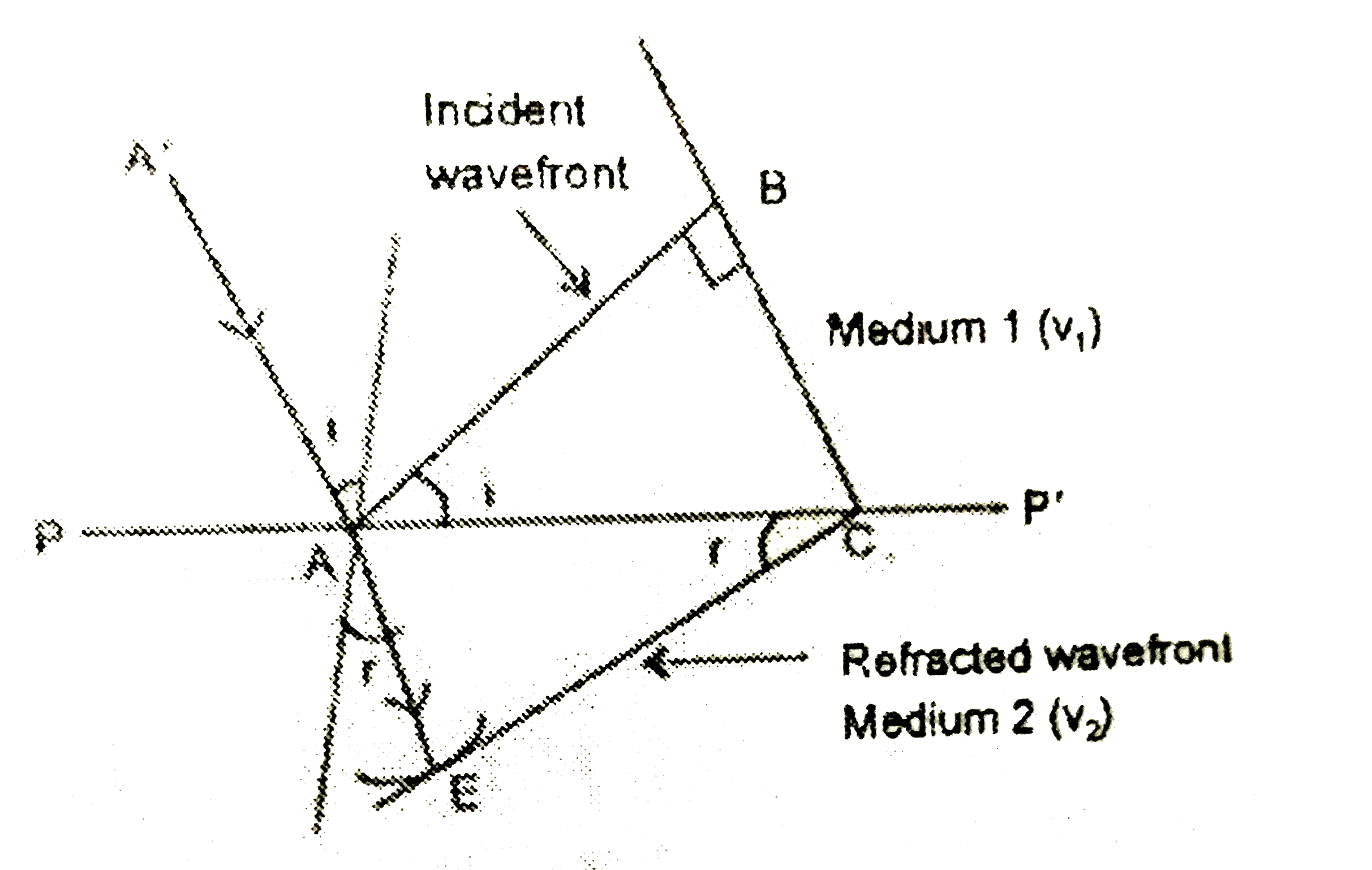
|
|