

Saved Bookmarks
| 1. |
How is junction diode formed ? Discuss the working of a junction diode as a full-wave rectifier. |
Answer» Solution :Formation of junction diode. When a p-type crystal is placed in contact with n-type crystal so as to form one piece, the assembly so obtained is called p-n junction or junction diode or crystal diode. The surface of contact of p-type and n-type CRYSTALS is called junction. In the psection, holes are the majority carriers while in n-section, the majority carriers are electrons. Due to high concentration of different types of charge carriers in the two sections, holes from p-region diffuse into n-region and electrons from n-region diffuse into p-region. In both cases, when an electron meets a hole they cancel the effect of each other and as a result, a thin layer at the junction becomes devoid of charge carriers. This is called depletion 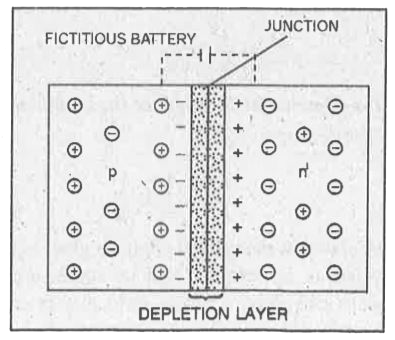 layer as shown in the figure. The thickness of depletion layer is of the order of `10^(-6)` m. Due to the migration of holes and electrons, the two sections of the junction diode no longer remain NEUTRAL. The p-section of the junction diode becomes slightly negative, while the n-section is rendered positive. Due to this, there is a potential gradient in the depletion layer, negative on the p-side and positive on the n-side. In other 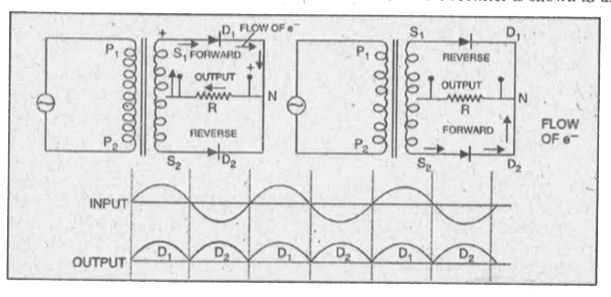 Working. During the positive half of input `AC, D_1` is forward biased and `D_2` reverse biased. Hence the current flows through the upper circuit as shown. During negative half, lower portion (`D_2`) is forward biased and upper (`D_1`) is reverse biased. words, it appears as if some fictitious battery is connected across the junction with its negative POLE connected topregion and positive pole connected to n-region. The potential difference developed across the junction diode due to migration of majority carriers is called potential barrier. Full wave RECTIFIER. The circuit diagram using junction diode as full wave rectifier is shown in the figure. Thus during each half, we get the current either from `D_1` and from `D_2`. The output voltage is unidirectional. |
|