

Saved Bookmarks
| 1. |
How will you measure the internal resistance of a cell by potentiometer? |
|
Answer» Solution :To measure the internal resistance of a cell, the circuit connections are made as shown in Figure. The END of the potentiometer wire is connected to the POSITIVE terminal of the battery B and the NEGATIVE terminal of the battery is connected to the end D through a key `K_1`. This forms the primary circuit. (ii) The positive terminal of the cell & whose internal resistance is to be determined is also connected to the end of the wire. The negative terminal of the cell `xi` is connected to a jockey through a galvanometer and a high resistance. 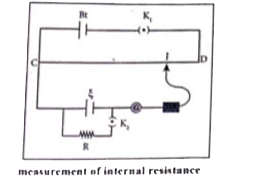 (iii) A resistance box R and key `K_2`, are connected across the cell `xi`. With `K_2`, open, the balancing point J is obtained and the balancing length `C_1`, = `1_1`, is measured. Since the cell is in open circuit, its emf is `xi =I_i "...(1)"` (iv) A SUITABLE resistance (say, `10 Omega`) is included in the resistance box and key K2 is closed. Let r be the internal resistance of the cell. The current passing through the cell and the resistance R is given by `I = xi /(R+r)` The potential difference a across R is `V = (xi R)/(R+r)` (v) When this potential difference is balanced on the potentiometer wire, let `l_1`, be the balancing length Then `(xi R)/(R+r) prop l_2"...(2)"` From equations (1) and (2) `(R+r)/R = l_2/l_2` `+r/R= l_2/l_2` `r = R[(l_1 l_2)/l_2]` `:."r = R" [(l_1 - l_2)/l_2]` (vi) Substituting the values of the R, `I_1`, and `l_1`, the internal resistance of the cell is determined. The experiment can be REPEATED for different values of R. It is found that the internal resistance of the cell is not constant but increases with increase of external resistance connected across its terminals. |
|