

Saved Bookmarks
| 1. |
How will you prepare ethyl amine from- (i) ethyl iodide (ii) phthalimide (iii) acetaldoxime (iv) acetonitrile? |
|
Answer» SOLUTION :(i) ETHYL iodide: When ethyl iodide is heated with excess of alcoholic ammonia, under pressure at 373 K ethanamine is obtained as a major product. `underset("ethyl iodide")(CH_(3)-CH_(2))-I+ underset("ammonia")underset("excess")underset(("alc."))(NH_(3))overset(Delta)(to) CH_(3)-underset("ethanamine")(CH_(2)-NH_(2))+HI` (ii) PHTHALIMIDE: Phthalimide is REACTED with alcoholic KOH to form potassium phtalimide. Further potassium phthalimide is treated with an ethyl iodide. The produce N-ethylphthalimide is hydrolysed wilth dilte HCl to form ethyl amine. This reaction is known Garbiel phthalimide synthesis. 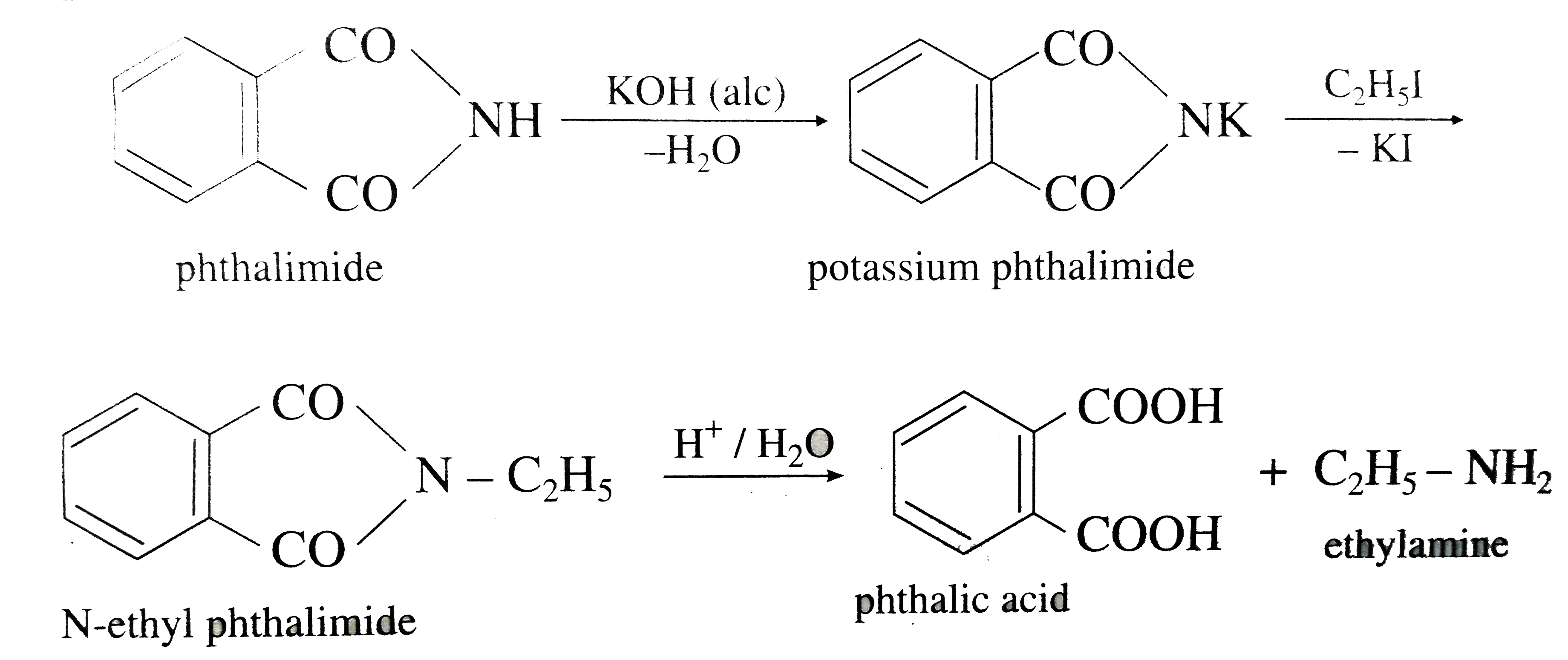 (iii) Acetaldoxime: AScetaldoxime on reduction with `Na` and alcohol forms ethylamine. `underset("acetaldoxime")(CH_(3)-overset(H)overset(|)(C)=N-)OH+4[H] underset(Delta)overset(Na//"ethanol")(to)CH_(3)-underset("ethyl amine")(CH_(2)-NH_(2)+H_(2)O` (iv) Acetonitrile: Methyl cyanide or acetonitrile on reduction by sodium and ethyl alcohol forms ethanamine. The reaction is called Mendius reduction. `underset("or methyl cyanide")underset("acetonitrile")(CH_(3)-C-=)N+4[H]overset(Na//"alcohol")(to)underset("or ethanamine")underset("ethylamine")(CH_(3)-CH_(2))-NH_(2)` |
|