

Saved Bookmarks
| 1. |
How would you account for the following: (a) of the d^(4) species, Cr^(2+) is strongly reducing while Mn^(3+) is strongly oxidizing, (b) Co^(2+) is stable in aqueous solution but in the presence of complexing reagents it is easily oxidised. (c) The d^(1) configuration is very unstable in ions. |
|
Answer» Solution :(a) The most common oxidation state of Cr is + 3, it has a tendency to change + 2 oxidation state to +3 after removing ONE ELECTRON. `Cr^(2+)` is a strong reducing agent. On the other hand, `d^(4)` configuration of `Mn^(3+)` has a strong tendency to change to `d^(5)` configuration of Mn (II), which is more stable due to PRESENCE of half filled d-orbital, thus Mn(III) is a strong oxidising agent. (B) Electronic configuration of Co (III) 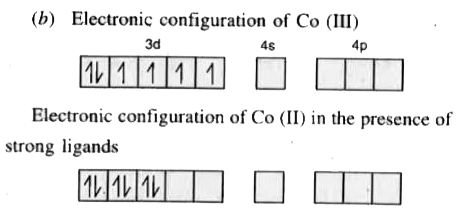 Co (III) complexes are more stable than Co (II) because in Co (III) has `d^(6)` electronic configuration. In the presence of strong ligands four unpaired electrons gel paired up and thus forms diamagnetic complexes. This arrangements has very large crystal field stabilization energy. Due to this reason Co (II) changes to Co (III) in the presence of strong ligands. (c) c) `d^(1)` configuration is very unstable in ions because after losing one more electron it will become stable, |
|