

Saved Bookmarks
| 1. |
(i) A yellow precipiate of the compound A is formed on passing H_(2)S through a neutral solution of the salt B. (ii) The compound A is soluble in hot dilute HNO_(3) but insoluble in yellow ammonium sulhpide. (iii) The The solution of B, on treatment with a small quantitity of NH_(3), gives a white precipitate soluble in an excess of the reagent, forming a compound C. (iv). The solution of B gives a white precipitate with a small concentration of KCN. the precipitate is soluble in an excess of the reagent, forming a compound D. (v) the solution of D, on treatment with H_(2)S, gives A. (vi) The solution of B in dilute HCl, on treatment with a solution of BaCl_(2), gives a white precipitate of the compound E, which is almost insoluble in concentrated HNO_(3). Q. Which of the following is the cation present in B? |
|
Answer» `As^(3+)` 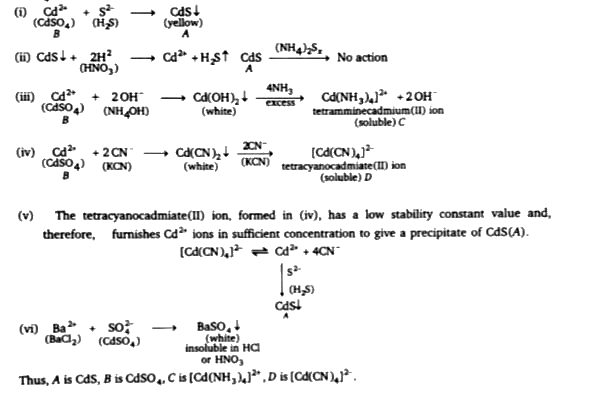
|
|