

Saved Bookmarks
| 1. |
(i) Ammonia is good complexing agent. Explain. (ii) PCI exists as [PCl_6]^(-)[PCl_4]^+but PBr_5exists as [PBr_4]^(+)[Br]^(-). Explain. (iii) Cl_5is known but PIs is not known. Why? (iv) Suggest a method for the laboratory preparation of DCI. Write a balanced equation for the reaction. (v) H_3PO_3is diprotic acid. Explain. |
|
Answer» Solution :(i) Ammonia is a good complexing AGENT because of the presence of lone pair of electrons on nitrogen. This lone pair can easily be donated to electron deficient compounds forming complexes. For example, it reacts with `Cu^(2+)`ion to form a deep blue complex. `Cu^(2+) (aq) + NH_3(aq) to underset("complex (deep blue)")([Cu(NH_3)_4]^(2+) )` On the other hand, `PBr_5`splits up into stable tetrahedral structure as : `[PBr_5] iff [PBr_4]^(+) [Br]^(-)` This SPLITTING is different from `PCl_5`because Br atoms are large and six atoms of Br cannot be easily accommodated around smaller P atom. (iii) Due to small size of Cl atom, five Cl atoms can be accommodated around P atom. But I is of large size and therefore, five I atoms cannot be accommodated around P atom. As a result, P-I bonds are weak and prefer to form`PI_3`rather than `PI_5` (iv) Hydrolysis of `PCl_5`with HEAVY water `(D_2O)`gives DCI `underset("heavy water ")(PCl_5 + D_2O) to POCl_3 + 2DCl` (v) `H_3PO_3`has THREE H atoms and therefore, it is expected to be tribasic. However, in its structure, two hydrogen atoms are JOINED through oxygen atoms and are ionisable. The third H atom is linked to P and is non-ionisable. 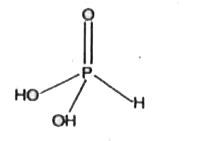 |
|